Swiss Re
Rate this: Use the stars above to vote, five stars being the highest rating.
Location:
Show on map
30 St Mary Axe, EC3
London
United Kingdom
coordinates:
51.5146790 -0.0805306
Building names(s): Swiss Re / 30 St Mary Axe / Gherkin / Bullet / Cucumber Building
Architect/Designer: Foster & Partners
Images: add an image <== click HereOther Information:
Completion date: 2004
Function: commercial
Website: www.30stmaryaxe.com/index2.aspCompletion Date: 2004
structural engineers: ARUP
Last update: 29 June, 2011 | Suggested By LT


(7 votes, average: 3.29 out of 5)
Londons first ecological tall building and an instantly recognisable addition to the citys skyline, 30 St Mary Axe is rooted in a radical approach – technically, architecturally, socially and spatially…
…Generated by a radial plan, with a circular perimeter, the building widens in profile as it rises and tapers towards its apex. This distinctive form responds to the constraints of the site: the building appears more slender than a rectangular block of equivalent size; reflections are reduced and transparency is improved; and the slimming of its profile towards the base maximises the public realm at ground level. Environmentally, its profile reduces the amount of wind deflected to the ground compared with a rectilinear tower of similar size, helping to maintain pedestrian comfort at street level, and creates external pressure differentials that are exploited to drive a unique system of natural ventilation.
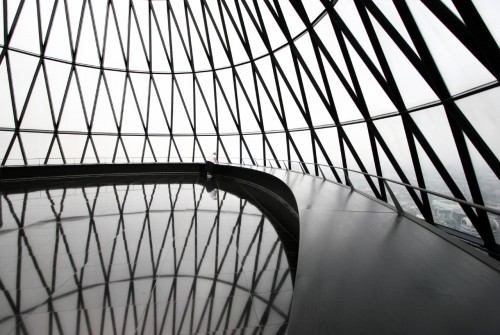
Conceptually the tower develops ideas explored in the Commerzbank and before that in the Climatroffice, a theoretical project with Buckminster Fuller that suggested a new rapport between nature and the workplace, its energy-conscious enclosure resolving walls and roof into a continuous triangulated skin. Here, the towers diagonally braced structural envelope allows column-free floor space and a fully glazed facade, which opens up the building to light and views. Atria between the radiating fingers of each floor link together vertically to form a series of informal break-out spaces that spiral up the building. These spaces are a natural social focus places for refreshment points and meeting areas – and function as the buildings lungs, distributing fresh air drawn in through opening panels in the faade. This system reduces the towers reliance on air conditioning and together with other sustainable measures, means that the building is expected to use up to half the energy consumed by air-conditioned office towers.
read more at fosterandpartners website
The building uses energy-saving methods which allow it to use half the power a similar tower would typically consume. Gaps in each floor create six shafts that serve as a natural ventilation system for the entire building even though required firebreaks on every sixth floor interrupt the “chimney.” The shafts create a giant double glazing effect; air is sandwiched between two layers of glazing and insulates the office space inside.
Architects limit double glazing in residential houses to avoid the inefficient convection of heat, but the Swiss Re tower exploits this effect. The shafts pull warm air out of the building during the summer and warm the building in the winter using passive solar heating. The shafts also allow sunlight to pass through the building, making the work environment more pleasing, and keeping the lighting costs down.