New Museum


(9 vote, 71.11% worth checking out)
Location:
Show on map & checkout the other sites nearby
235 Bowery
NY 10002
New York
USA
coordinates: 40.7222672,-73.9931717
open coordinates in google maps
open coordinates in apple map
Building names(s): New Museum
Architect/Designer: SANAA + - Sejima & Nishizawa
Images: add an image <== click Here
Show on map & checkout the other sites nearby 235 Bowery
NY 10002
New York
USA
coordinates: 40.7222672,-73.9931717
open coordinates in google maps
open coordinates in apple map
Building names(s): New Museum
Architect/Designer: SANAA + - Sejima & Nishizawa
Images: add an image <== click Here
Completion date:
function(s): museum
Architects: SANAA – Kazuyo Sejima and Ryue Nishizawa
Executive Architect: Gensler
Opening Hours:
- Wednesday 12-6 PM
- Thursday and Friday 12-10 PM
- Saturday and Sunday 12-6 PM
- Monday and Tuesday closed
- The seventh floor Sky Room with panoramic views is open on weekends only.
- The Museum is closed to the public on Monday and Tuesday and on Thanksgiving Day, Christmas Day, and New Years Day.
- CIT Free Thursday Evenings (from 7 PM to 10 PM
Museum website: www.newmuseum.org
suggested on: 4 December 2008 |
Suggested By sobky
1 comment/review
Quoted from the New York Times says:
Dec 4, 2008
The New Museum building was built on a relatively modest budget of $50 million (for 5,570 m2).
The intent to stay tethered to what was left of the rough-and-tumble downtown art scene, moved the institution from SoHo to the Bowery in an effort to tap into its history – its uninhibited characters, seedy settings and, above all, rejection of bourgeois tastes.
The seven-story building stands amid the remnants of this forgotten landscape and a new one. Dirty brick facades flank it on two sides. SoHo’s glitzy boutiques and showrooms are a few blocks to the west; the cheap, pretentious glass towers that embody the latest wave of gentrification are rising to the east and north.
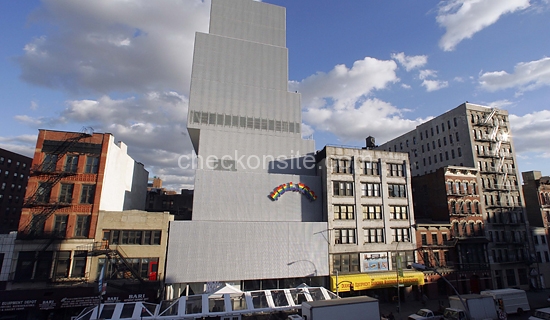
The museum serves as a hinge between these two worlds. As it rises, its floors shift back and forth like a pile of boxes stacked ever so carefully. Its protective armor of aluminum mesh is a great ornamental screen. Exquisitely detailed, it is backed by a second layer of metal panels, giving the surface a subtle depth.
What results is a striking expression of the neighborhood’s warring identities. When the building is approached from Prince Street, the contrast between the instability of the forms and the uniformity of the aluminum gives it a strangely enigmatic glow, evoking both a fading past and a phantom future. As you get closer, the skin becomes tougher and more industrial, echoing what’s left of the neighborhood’s grittier history.
The formal ambiguity is coupled with a fierce desire to bridge the divide between art and everyday life. Only a thin sheet of floor-to-ceiling glass separates the sidewalk from the museum’s ground floor. Inside a lobby and loading dock are set side by side, so that pedestrians can watch the art being moved in and out of the building or gaze across to a small cafĂ© and gallery at the rear of the lobby. From here, visitors can contemplate the chaos of the city in relative silence.
It’s only when you ascend to the upper floors that you begin to glean the meaning of the museum’s unusual form. By shifting the positions of the floors, the architects were able to create narrow skylights along the outer edges of the galleries, allowing a soft, diffuse sunlight to wash down their white walls.