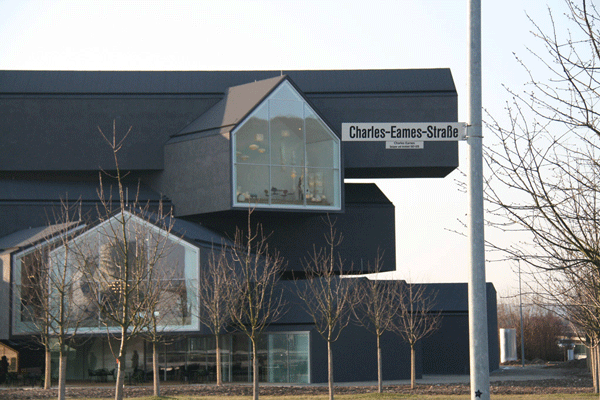
Vitrahaus


(3 vote, 80.00% worth checking out)
Show on map & checkout the other sites nearby Charles-Eames-Str. 1
Weil am Rhein
Germany
coordinates: 47.6029205,7.6178384
open coordinates in google maps
open coordinates in apple map
Building names(s): Vitrahaus
Architect/Designer: Herzog & de Meuron
Images:
Completion date:
function(s): retail, showroom
As the purpose of the VitraHaus is to display home furnishings, the architects of the VitraHaus, Herzog & de Meuron, took up the idea of the “archetypal house”, as the proportions and dimensions of the rooms bring to mind residential space that is familiar to us – the architects use the term “domestic scale”.
hours:
VitraHaus, VitraHaus Café, Vitra Design Museum and Shop
Mon-Sun: 10.00-18.00,
except Thu: 10.00-20.00
guided architectural tours: approx 2 hours on the Vitra Campus. Daily at 11 a.m., 1 p.m. and 3 p.m.
getting there: From Claraplatz or Badischer Bahnhof Basel, take bus 55 to Vitra. From EuroAirport Basel-Mulhouse-Freiburg, take bus 50 to the Basel SBB Railway Station, tram 2 to Badischer Bahnhof Basel, bus 55 to Vitra.From the train station in Weil am Rhein, it is about a 15 minute walk to the museum.
1 comment/review
David Basulto says:
Apr 20, 2010
The concept of the VitraHaus connects two themes that appear repeatedly in the oeuvre of Herzog & de Meuron: the theme of the archetypal house and the theme of stacked volumes. In Weil am Rhein, it was especially appropriate to return to the idea of the ur-house, since the primary purpose of the five-storey building is to present furnishings and objects for the home. Due to the proportions and dimensions of the interior spaces – the architects use the term ‘domestic scale’ – the showrooms are reminiscent of familiar residential settings. The individual ‘houses’, which have the general characteristics of a display space, are conceived as abstract elements. With just a few exceptions, only the gable ends are glazed, and the structural volumes seem to have been shaped with an extrusion press. Stacked into a total of five stories and breathtakingly cantilevered up to 49 feet in some places, the twelve houses, whose floor slabs intersect the underlying gables, create a three-dimensional assemblage – a pile of houses that, at first glance, has an almost chaotic appearance.
The charcoal color of the exterior stucco skin unifies the structure, ‘earths’ it and connects it to the surrounding landscape. Like a small, vertically layered city, the VitraHaus functions as an entryway to the Campus. A wooden plank floor defines an open central area, around which five buildings are grouped: a conference area, an exhibition space for the chair collection of the Vitra Design Museum and a conglomerate comprising the Vitra Design Museum Shop, the lobby with a reception area and cloakroom, and a café with an outdoor terrace for summer use. A lift takes visitors to the fourth storey, where the circular tour begins. Upon exiting the lift, the glazed northern end of the room offers a spectacular view of the Tüllinger Hill. The opposite end – where the glass front is recessed to create an exterior terrace – opens to a panorama of Basel with the industrial facilities of the pharmaceutical sector. As one discovers on the path through the VitraHaus, the directional orientation of the houses is hardly arbitrary, but is determined by the views of the surrounding landscape.