Vitra Fire Station
Rate this: Use the stars above to vote, five stars being the highest rating.
Location:
Show on map
Charles-Eames-Straße 1
Weil am Rhein
D 79576
Germany
coordinates:
47.6002312 7.6145768
Building names(s): Vitra Fire Station
Architect/Designer:
Zaha Hadid
architect website: www.zaha-hadid.com
Other Information:
Completion date: 1994
Function: firestation
>Hours:Monday – Sunday: 10 a.m. – 6 p.m. Wednesday: 10 a.m. – 8 p.m. Closed: December 24 – 25, December 31, January 1, and also during preparations between its temporary exhibitions – so check first: call +49 7621 702 3200, email [email protected] or visit www.design-museum.de (select Vitra Design Museum, not the one in Berlin).
The only way to see the Fire Station and buildings other than the design museum itself is to take a 2-hour guided architectural tour (usually in German except by arrangement or if there are a sufficient number of English-speakers). Currently these take place at 12pm and 2pm, but call the number above to check first or to arrange for private tours in German, English, French or Italian.
Getting there:
The museum is in Germany, but the closest city is Basel in Switzerland. By car, from Frieburg (North) or Basel (South) take the autobahn A5 (exit Weil am Rhein, then signposted). From France/St Louis take the border crossing Palmrain. From Lörrach/Riehen turn west at the junction marked ‘Weil am Rhein’ just North of the Fondation Beyeler.
By public transport from Basel, take bus number 55 which stops right outside the museum at the entrance to the Vitra site. Or from the train station in Weil am Rhein it is a 15-minute walk.
Last update: 30 June, 2011 | Suggested By LT

(5 votes, average: 4.00 out of 5)
(5 votes, average: 4.80 out of 5)
The Vitra Fire Station in Weil am Rhein was Zaha Hadid’s first built project. The relatively small structure serves as a showcase for the unusual shapes and angles that architectural critics had admired in her conceptual work throughout the 1980s, with un-built projects such as her winning entry for the Peak International Design Competition for Hong Kong in 1983.
Constructed as a working firehouse within the Vitra furniture design and manufacturing complex (after a fire some years earlier proved the need for such a structure), the building was intended to serve all of Vitra’s buildings which at the time fell outside the range of neighboring fire districts. The firehouse thus became part of Vitra’s program of building structures by world renowned architects, including Tadao Ando’s Conference Pavilion, Frank Gehry’s Design Museum and Alvaro Siza’s Production Hall.
When in use the firehouse was staffed by volunteers who worked in the Vitra factory. The building functioned as a firehouse until the fire district lines were re-drawn and the Vitra complex was finally covered by a nearby fire department. This rendered the building partially obsolete, and it was for this reason (and not the rumored error on Hadid’s part of not allowing enough room in the building to house fire trucks) that the building is now used by Vitra as a showplace for part of its permanent collection of chairs.
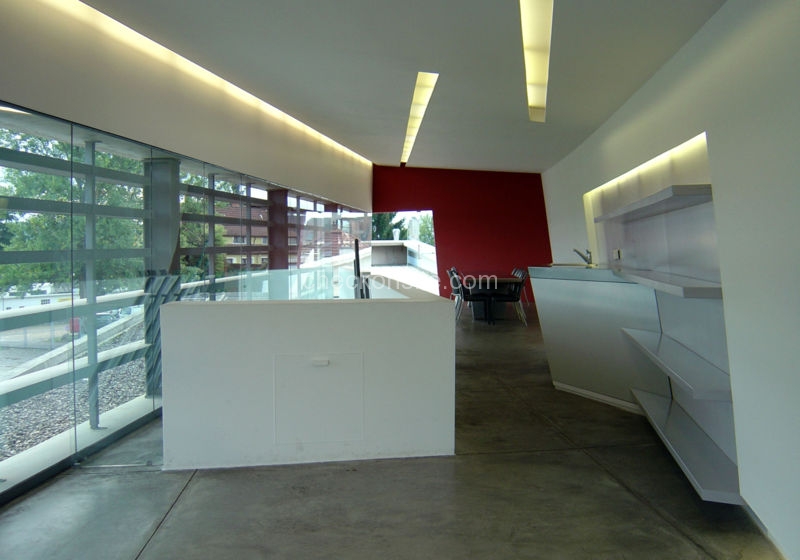
As can be expected, the inside of the building is as imaginative as the outside, with multiple optical tricks being played on the viewer especially in the bathrooms of the downstairs portion of the building. Hadid’s interplay of angles and use of color makes the building’s interior as visually interesting as the outside without making it unnecessarily busy. Aside from the obvious appeal of the building’s outside, it should be noted that the back of the building also features poured concrete benches which mirror the buildings more sculptural qualities. The rear end of the building also features an interesting connection to Le Corbusier’s Notre Dame du Haut, whereby Hadid seems to evoke the front end of a large ship, with its sharp end and exaggerated height.