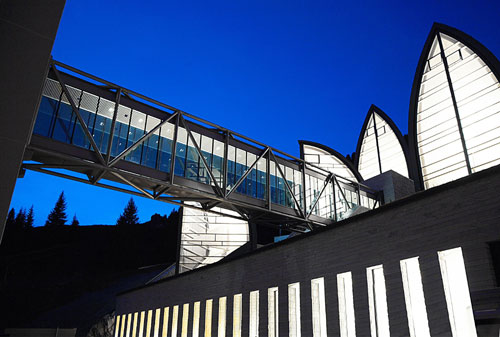
Tschuggen Bergoase spa
Rate this: Use the stars above to vote, five stars being the highest rating.
Location:
Show on map
Tschuggen Grand Hotel
Sonnenbergstrasse 1 (near St. Moritz)
Arosa
Switzerland
coordinates:
46.7772217 9.6708975
Building names(s): Tschuggen Bergoase spa
Architect/Designer: Mario Botta
Images: add an image <== click HereOther Information:
Completion date: 2006
Function: spa
Spa website: www.tschuggen.chArea: 3,500sq m (37,700sq ft)
- spread over four floors and linked to the hotel by a glass bridge.12 treatment rooms, two swimming pools, indoor and outdoor saunas, a hammam, a meditation room, a fitness centre and a junior spa suite. The spa will also feature a Kniepp Path – where guests will walk over natural stones through a knee-deep stream of water – and the Arosa Mountain Grotto.
Last update: 13 October, 2011 | Suggested By M2S

(4 votes, average: 4.00 out of 5)
The setting is spectacular. Bergoase (“mountain oasis” in German) was carved into the mountainside at an elevation of 5900 feet (1,800 meters) near Arosa, a ski resort village of 2,000 inhabitants. Tall steel and glass light scoops projecting up from the spa imitate the jagged, snow-covered mountain peaks beyond, and at the same time resemble cathedral windows. A watery-blue glass bridge with white granite floors provides a transition between the sporty 1960′s five-star hotel and the reception area of the spa.
Day visitors arriving at the spa’s ground floor are greeted by a different transitional space — a sober granite stairway that leads to the same reception area on the third floor. But the effect is the same: the passageways send a message that this new place is set apart from the usual world where everything clamors for attention.
Inside the spa, the light, open space encourages quiet and reflection. Entering becomes a metaphor for taking steps inside oneself and proffers an opportunity for cherishing rare moments of meditative calm, much like one might find in a temple.
Sanctuary for Meditation
Botta, who is admired for the Evry Cathedral in France, the Cymbalist Synagogue in Tel Aviv, and the Santo Volto Church in Turin, says, “the person who visits a spa doesn’t go only for a workout or pool. He wants an environment that also nourishes the spirit.”
The architect relies on traditional materials and elements to evoke a connection with nature. Duke White™ granite from the Domdossola, Italy area covers walls, floors, showers, and the pool of the 57,000-square-foot (5,300-square-meter) spa. The stone, selected for its durability and resistance to variations in temperature — from freezing cold to the heat in the saunas — was treated in the pool and salon areas to protect it from chlorine and disinfectants.
The Italian company, Testigroup, which prepares stone for sculptures, used the same treatment on the pool-area stonework as on statues to protect them from humidity and the outdoor elements.
In the ceilings, Canadian maple forms triangles and rounded slats to add a graphic quality to the overhead space while ensuring an optimum level of acoustics with a silence rarely found in today’s world. The slate-gray interior walls and natural lighting also soften the space making it conducive to calm and reflection.
The massive textured granite wall behind the pool curves and dips as in a cave. Italian stoneworkers cut and numbered the pieces in Verona and reassembled them in Arosa — a job that required approximately four months. Cascades fall along the wall into the indoor and outdoor pools, and a rounded grotto veiled by a rain curtain offers opportunities to experience the four seasons through showers, lights, sounds, and floral scents.
Carved from Rock
The space, with an interior volume of 35,000 cubic yards (27,000 cubic meters), is designed in a style that Botta calls “essential.” Only the skylights, the exterior granite wall on the ground floor and some glass windows on one side remain visible from the parking area.
Restrained to a space behind the hotel, Botta settled on simplicity and the idea of cutting into the rock. “I used volume rather than space. It’s all inside, not out,” he says. Workers excavated 30,000 cubic yards (23,000 cubic meters) of rock and earth which contributed to the cost of what one German newspaper deemed Europe’s most expensive spa. Much of the stone went into concrete for the building’s construction.
The four levels of the spa conform to the original slope of the mountain and disappear underground beneath turf and snow. The steel and glass “light trees” perch at different levels and offer up spectacular mountain views from inside. To maintain these views, a window-heating system keeps the large, glazed surface areas steam-free on the inside and snow-free on the outside.
The four levels of the spa descend in steps down the mountain slope —- with the pool located on the top floor, followed by the saunas and bridge on the level below, then the beauty and massage center, and finally the gym, fitness and meditation rooms on the ground floor. From inside, all four floors are visible to each other and interact in an open volume of space from the pool down to the workout room.
Botta asserts: “a good spa, like any architecture, should evoke emotion. I wanted to evoke a sense of protection for people who are inside and at the same time create a connection with the vast mountain space outside and give a sense of infinity.” In the weeks before the opening, spa management wanted to add bright colors to the interior, but Botta resisted, insisting on a space that appears as natural and pure as the pristine alpine landscapes outside.
Is it a contradiction to design a spa with spiritual values in mind? Botta believes that, “one must think beyond the function and respond to the moral and spiritual elements. It’s a beautiful idea to think of exiting from a spa with the same feeling as one would have leaving an Indian temple, for example. The body also regenerates if it has the possibility of being in contact with elements of nature.”
Botta generates a rare place of tranquility for spa visitors, a meditative, even sacred space for regenerating the body. The design neither imposes nor insists on any single perspective, but opens up in many different angles for one to enjoy the snow-covered alps in silence, to turn inward and reflect, or simply to lounge by the pool and read a book in a peaceful environment.