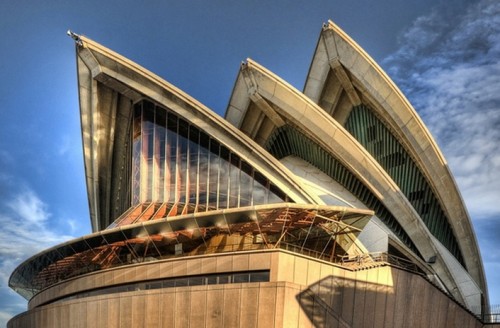
Sydney Opera House
Rate this: Use the stars above to vote, five stars being the highest rating.
Location:
Show on map
Circular Quay
Sydney
Australia
coordinates:
-33.8566971 151.2150116
Building names(s): Sydney Opera House
Architect/Designer: Jorn Utzon
Images: add an image <== click HereOther Information:
Completion date: 1973
Function: auditorium
Structural engineer : Ove Arup & PartnersCompleted: 1973 opened by Queen Elizabeth II on 20 October 1973
Website: www.sydneyoperahouse.com
first performance: The Australian Opera’s production of War and Peace by Prokofiev
Cost: $AU 102,000,000 to build
Last modified: 29 June, 2011 | Suggested By LT


(8 votes, average: 3.88 out of 5)
Utzon explained his design as follows: “…the idea has been to let the platform cut through like a knife and separate primary and secondary functions completely. On top of the platform the spectators receive the completed work of art and beneath the platform every preparation for it takes place.”
Utzon continued, “To express the platform and avoid destroying it is a very important thing, when you start building on top of it. A flat roof does not express the flatness of the platform…in the schemes for the Sydney Opera House…you can see the roofs, curved forms, hanging higher or lower over the plateau. The contrast of forms and the constantly changing heights between these two elements result in spaces of great architectural force made possible by the modern structural approach to concrete construction, which has given so many beautiful tools into the hands of the architect.”
The shells of the competition entry were originally of undefined geometry,[5] but early in the design process the “shells” were perceived as a series of parabolas supported by precast concrete ribs. However, engineers Ove Arup and partners were unable to find an acceptable solution to constructing them. They had to find a way in which to economically construct the shells from precast concrete, because the formwork for using in-situ concrete would have been prohibitively expensive. Without repetition in the roof forms the construction of precast concrete would also be too expensive.
From 1957 to 1963 the design team went through at least twelve iterations of the form of the shells (including schemes with parabolas, circular ribs and ellipsoids) before a workable solution was completed. The design work on the shells involved one of the earliest uses of computers in structural analysis in order to understand the complex forces the shells would be subject to.[6] In mid-1961 the design team found a solution to the problem: the shells all being created as sections from a sphere.
read more at answers.com
Inaugurated in 1973, the Sydney Opera House is a great architectural work of the 20th century that brings together multiple strands of creativity and innovation in both architectural form and structural design. A great urban sculpture set in a remarkable waterscape, at the tip of a peninsula projecting into Sydney Harbour, the building has had an enduring influence on architecture. The Sydney Opera House comprises three groups of interlocking vaulted ‘shells’ which roof two main performance halls and a restaurant. These shell-structures are set upon a vast platform and are surrounded by terrace areas that function as pedestrian concourses. In 1957, when the project of the Sydney Opera House was awarded by an international jury to Danish architect Jørn Utzon, it marked a radically new approach to construction.
read more at unesco.org
Looks good. Pitty the inside is so crap.