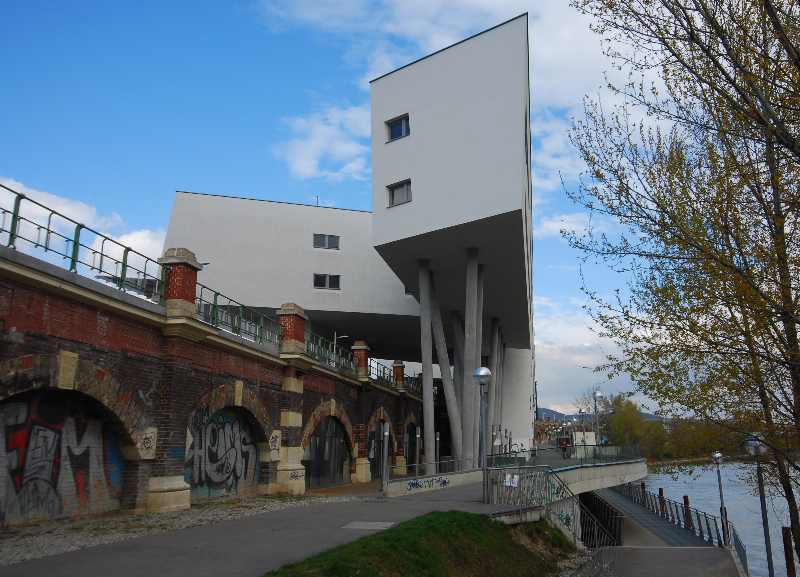
Spittelau Social Housing
Rate this: Use the stars above to vote, five stars being the highest rating.
Location:
Show on map
Spittelauer Lände 9
Vienna
1090
Austria
coordinates:
lat 48.2318344, long 16.3613682
Building names(s): Spittelau Social Housing / Spittelau Viaduct
Architect/Designer: Zaha Hadid
Images: add an image <== click HereOther Information:
Completion date: 2005
Function:
program: Housing, restaurants, bars, officessize: 4,000m²
getting there: U-Bahn (underground) lines U4 and U6, exit at Spittelau station.
concept: Multi-Family Housing / mixed use
A series of apartments, offices and artist’s studios weave like a ribbon through, around and over the arched bays of the viaduct, designed by Otto Wagner. The viaduct itself is a protected structure, and may not be interfered with. The three-part structure playfully interacts with the viaduct, generating a multitude of different outdoor and indoor spatial relationships. The perception of these is intensifed by the response of the architectural language to the different speeds of the infrastructural elements. Public outdoor spaces are enlivened via the infill of bars and restaurants under the arches of the viaduct. The related service zone flows through the remaining openings of the viaduct and melts into the banks of the canal, creating a lively platform for public life. The rooftops are planned as private retreats and add to the visual activity along the canal. An additional challenge is posed to the project, as the program consists mainly of social housing, though studios and offices are mixed in. Later, the project should be connected to the University of Business and Northern Train Station via a pedestrian and cycle bridge.
Last modified: 18 July, 2010 | Suggested By kiwi kid


This new mixed-use project in the Spittelau district is an island of development caught within an extraordinary confluence of different infrastructures. To one side the scheme addresses the Donaukanal – a conduit derived from the Danube which cuts along the historic city’s eastern edge. On the other, it faces a metroline and two major roads – all running parallel to the canal’s broadly north-south course. The 20m-wide sliver held between these routes would have presented a considerable architectural challenge at the best of times. The fact that a viaduct – abandoned but protected as a historic monument – cuts it in two meant that for many years the land was written off as unfit for building.
The viaduct is the work of Otto Wagner and belongs to the Stadtbahn, the city railway network that he built over six years from 1894. Comprising 30 stations and stops and 45km of track, the system is Vienna’s largest structure forming a continuous belt, a couple of miles outside the circuit of the Ringstrasse. Although the stretch running through Hadid’s site has been superceded – and now serves as a cycleway – much remains in its original use.
The city had long recognised the elevated route’s untapped potential as a vehicle for regenerating the peripheral districts that sat along its course. In 1994 it commissioned a series of studies for key sites along the circuit prior to selectively selling off many of the spaces beneath its arches.
Hadid’s design began as one such study. Her proposal comprised three buildings, each straddling the gently raking viaduct without making contact. These were to be occupied by artists’ studios, offices and commercial spaces on the upper storeys with shops, cafes and restaurants sited at ground level. In addition, an old subway tunnel – extending away from the northern end of the site – was to be transformed into a nightclub. It was proposed that given such a range of uses and such a bold architectural articulation the scheme stood a chance of bucking the constraints of its isolated site, becoming a vibrant destination in its own right. The students of the University of Economics – which sits 100m to the west – were identified as a key target audience. A new pedestrian and cycle bridge would establish a direct link across the intervening canyon of traffic.
The study scheme became a live project once it was taken over by SEG – a developer which had previously realised projects in the city with Coop-Himmelb(l)au and Jean Nouvel. At this point SEG’s search for a viable development equation required some brutal trimming of Hadid’s vision. The remodelling of the subway tunnel and the bridge link were dropped while the new buildings were reassigned as high-end housing. SEG planned to sell the units in advance of construction in order to release capital to fund the development. However, when tested against the market this scenario was also found to be unworkable.
The logic of what followed next is rather harder to follow. SEG calculated that if the project could be reconfigured as social housing it would be possible to secure sufficient public funding for it to proceed. Rather than the generous loft-like interiors Hadid had originally envisaged, the blocks would now be carved up between 31 smaller units. 16 of these – the ones facing the traffic – wouldn’t even be of standard social housing dimensions. Intended to be occupied principally by students, these mini-units would be made available on a maximum two-year lease.
This ludicrous turn of events has been widely criticised in Vienna. Whatever the scheme’s value in urban regeneration terms, at e10 million (£7 million), it has to be a shoo-in for the title of the most expensive social housing in the world.
This change led to Hadid ceding all involvement in the design of the interiors. In what became a form of design-and-build contract, responsibility for the configuration of the flats was handed to the design office of the main contractor. The new brief also required some significant revisions to the buildings’ exterior treatment. They had originally been conceived as steel structures replete with floor to ceiling glazing. The strategy proved impossible to reconcile with the rigorous environmental standards all Austrian social housing has to meet. The area of glazing was much reduced and Hadid made the shift to an in-situ concrete structure. Her hope was that this might be left exposed throughout. But the budget couldn’t run to the double-pour construction such a strategy would have required. Ultimately it was agreed that the walls and external soffits would be faced in insulated render.
What makes this saga all the more tragic is that, judged in purely formal terms, the project is one of Hadid’s most compelling. The original design dates from a key moment in the evolution of her vocabulary. It is one of the last works her office produced prior to its adoption of computer modelling as a principal design tool. That change would usher in a new generation of curvilinear designs that appear to all but grow out of the ground on which they sit. At Spittelau, the relationship between building and ground is still very much that suggested by the early paintings – the ground is a frictionless plane on which the building forms glide and overlap. It is notable that Spittelau shares many characteristics with the other Hadid project dating from 1994, the Cardiff Bay Opera House. As at Cardiff, the free form-plan is counterpointed by a rigorously pursued sectional idea. The roofline and the height of the underside of the elevated volumes are common across all three buildings. These horizontal data also offer a measure to the rise and fall of the complex ground conditions below.
This is a project that presents a dramatically different aspect to each of its sides. Approaching from the south, much of the scheme’s mass is concealed. With the hills beyond the city visible as a backdrop, the project might almost be read as a city gate. To the peace and views of the canal, it presents a relatively dense wall of development. Four elevations – two of which belong to the same meandering building – are tightly packed together, establishing a relatively conventional urban image when viewed obliquely down the towpath. It is on the opposing side that the flailing plan and the canting of many of the wall surfaces registers most dramatically. Passing by – whether on foot, car or metro – the gaps through to the river open up and close down again in a precisely choreographed manner. One’s sense of one’s own movement through space is made unusually vivid.
Despite the design’s traumatic history and the considerable failings of its interiors, I can find little fault with the exterior. In fact I rather think that some of the amendments Hadid had to take on board have been for the better. In particular, the white rendered finish generates a beautiful quality of light where the buildings come close to one another or wrap around themselves. Crucially, it also serves to bring the scheme into closer relationship with the buildings on the far side of the canal, which are finished in a similar manner.
The project therefore takes on the character of a middle condition – somewhere between architecture and infrastructure – and successfully draws its fragmented surroundings into a common composition. Three white elephants they may be, but for all their inherent preposterousness, these are still rather magnificent creatures