Seattle Public Library


(5 vote, 80.00% worth checking out)
Show on map & checkout the other sites nearby 1000 Fourth Ave.
WA 98104
Seattle
USA
coordinates: 47.6060600,-122.3329544
open coordinates in google maps
open coordinates in apple map
Building names(s): Seattle Public Library / Seattle Central Library
Architect/Designer: OMA
Images:
Completion date: May 2004
function(s): library
project architects: Rem Koolhaas, Joshua Ramus
Library website: http://www.spl.org
Hours:
Mon – Thurs: 10 am – 8 pm
Fri/Sat: 10 am – 6 pm
Sun: Noon – 6 pm
Total concrete – 18,400 cubic yards; rebar: 2,050 tons. The concrete in the library would cover 10 football fields 1-foot deep.
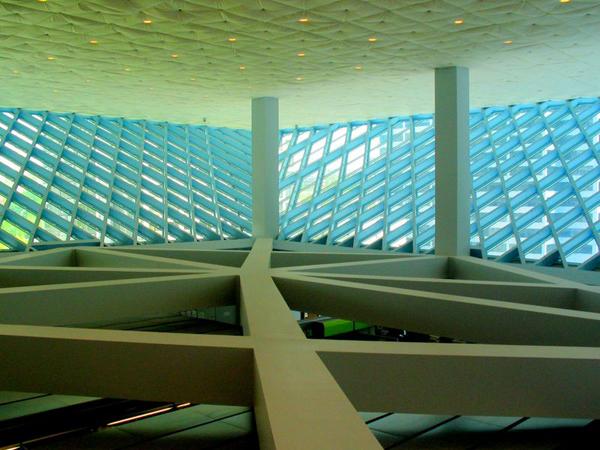
Total steel – 4,644 tons. If you compared the weight of the Statue of Liberty to the weight of the steel in the Central Library, there would be enough steel to make 20 statues. The diagonal grid system is designed to withstand lateral forces caused by wind or earthquakes.
Total pieces of exterior glass – 9,994; square footage of exterior curtain wall: 126,767; square footage of interior glazing: 28,963. The glass in the library would cover 5 ½ football fields. About half of the building’s panes are triple-layered glass with an expanded metal mesh sandwiched between the two outer layers. The mesh, aluminum sheet metal that is cut and stretched, reduces heat and glare. Most of the glass is cleaned twice a year, and more often for surfaces that need it.
2 comments/reviews
reviews on wikipedia says:
Apr 20, 2010
The opinion of architectural critics and the general public has been mixed; many like the new library but are less fond of its unusual design. Paul Goldberger, writing in The New Yorker, declared the Seattle Central Library “the most important new library to be built in a generation, and the most exhilarating.”[6] The American Council of Engineering Companies (ACEC) of Washington awarded the Library its Platinum Award for innovation and engineering in its “structural solutions”. The library also received a 2005 national AIA Honor Award for Architecture.[3]
Recently Lawrence Cheek, the architecture critic for the Seattle Post-Intelligencer, reconsidered his earlier praise. Cheek revisited the building in 2007 and found it “confusing, impersonal, uncomfortable, oppressive” on the whole, with various features “decidedly unpleasant,” “relentlessly monotonous,” “badly designed and cheesily detailed,” “profoundly dreary and depressing,” and “cheaply finished or dysfunctional,” concluding that his earlier praise for the building was a “mistake.”[4]
The library was also roundly condemned by the Project for Public Spaces, which noted “if the library were a true ‘community hub,’ its most active areas would connect directly to the street, spinning off activity in every direction. That is where Koolhaas’s library, sealed away from the sidewalks and streets around it, fails completely.” It went on to note “critics have cast it as a masterpiece of public space design. As if blinded by the architect’s knack for flash and publicity, they cannot locate, or perhaps refuse to acknowledge, the faults in his creation.”[7]
On the other hand, usage of the building is more than double the predicted volume.[8] In the library’s first year, 2.3 million individuals came to visit the library, roughly 30% were out-of-town. The library was also found to have generated $16 million in new economic activity for its surrounding area during this period
wikipedia on Design says:
Apr 20, 2010
The architects conceived the new Central Library building as a celebration of books, deciding after some research that despite the arrival of the 21st century and the “digital age,” people still respond to books printed on paper. The architects also worked to make the library inviting to the public, rather than stuffy, which they discovered was the popular perception of libraries as a whole.
Although the library is an unusual shape from the outside, the architects’ philosophy was to let the building’s required functions dictate what it should look like, rather than imposing a structure and making the functions conform to that.
For example, a major section of the building is the “Books Spiral,” (designed to display the library’s nonfiction collection without breaking up the Dewey Decimal System classification onto different floors or sections). The collection spirals up through four stories on a continuous series of shelves. This allows patrons to peruse the entire collection without using stairs or traveling to a different part of the building.
Other internal features include; the Microsoft Auditorium on the ground floor, the “Living Room” on the third floor (designed as a space for patrons to read), the Charles Simonyi Mixing Chamber (a version of a reference desk that provides interdisciplinary staff help for patrons who want to have questions answered or do research), and the Betty Jane Narver Reading Room on level 10 (with views of Elliott Bay).
New functions include automatic book sorting and conveyance, self-checkout for patrons, pervasive wireless communications among the library staff, and over 400 public computer terminals.