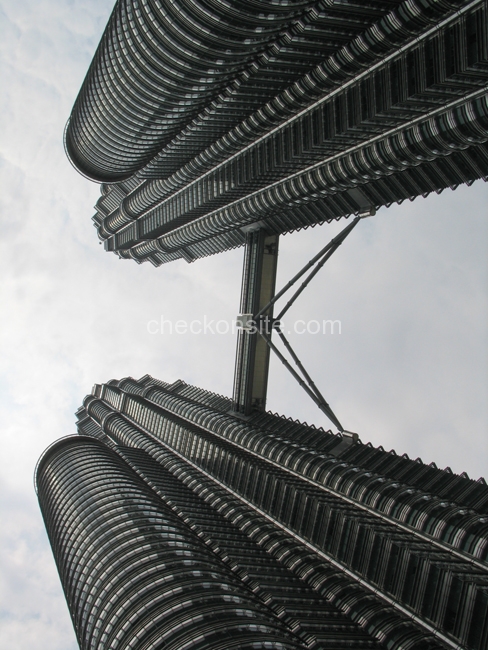
Petronas Twin Towers (KLCC)


(6 vote, 93.33% worth checking out)
Location:
Show on map & checkout the other sites nearby
Kuala Lumpur
Malaysia
coordinates: 3.1575277,101.7117920
open coordinates in google maps
open coordinates in apple map
Building names(s): Petronas Twin Towers (KLCC)
Architect/Designer: César Pelli
architect website:
Images: add an image <== click Here
Show on map & checkout the other sites nearby Kuala Lumpur
Malaysia
coordinates: 3.1575277,101.7117920
open coordinates in google maps
open coordinates in apple map
Building names(s): Petronas Twin Towers (KLCC)
Architect/Designer: César Pelli
architect website:
Images: add an image <== click Here
Completion date:
function(s): commercial, tower
completion date: 1998
website: http://www.petronastwintowers.com.my
Visitor Tips & Guidelines
* Limited number of tickets are issued per day on a first-come-first-served basis.
* Each visitor is entitled to only one ticket, and one ticket entitles to only one admission.
* Every child must be accompanied by an adult
* No advanced or group booking
* Admission is FREE
suggested on: 8 December 2008 |
Suggested By Ciara
1 comment/review
LT says:
Dec 8, 2008
Designed by Argentine-American architect César Pelli, the Petronas Towers were completed in 1998 and became the tallest buildings in the world on the date of completion. They were built on the site of Kuala Lumpur’s race track. Because of the depth of the bedrock, the buildings were built on the world’s deepest foundations. The 120-meter foundations were built by Bachy Soletanche, and required massive amounts of concrete.
The 88-floor towers are constructed largely of reinforced concrete, with a steel and glass façade designed to resemble motifs found in Islamic art, a reflection of Malaysia’s Muslim religion. Another Islamic influence on the design is that the cross-section of the towers is based on a Rub el Hizb (albeit with circular sectors added to meet office space requirements).
In an unusual move, a different construction company was hired for each of the towers. Tower 1 was successfully completed by Hazama Corporation. The builders of Tower 2, Samsung Engineering & Construction and Kukdong Engineering (both of South Korea) found a problem during the construction, the tower was estimated to lean 25mm on the ground with its own weight. The Tower 2 construction team succeeded one month earlier than tower 1.
Due to a lack of steel and the huge cost of importing steel, the towers were constructed on a cheaper radical design of super high-strength reinforced concrete. High-strength concrete is a material familiar to Asian contractors and twice as effective as steel in sway reduction; however, it makes the building twice as heavy on its foundation than a comparable steel building. Supported by 23-by-23 meter concrete cores and an outer ring of widely-spaced super columns, the towers use a sophisticated structural system that accommodates its slender profile and provides from 1300 to 2000 square metres of column-free office space per floor.Below the twin towers is Suria KLCC, a shopping mall, and Dewan Filharmonik Petronas, the home of the Malaysian Philharmonic Orchestra.