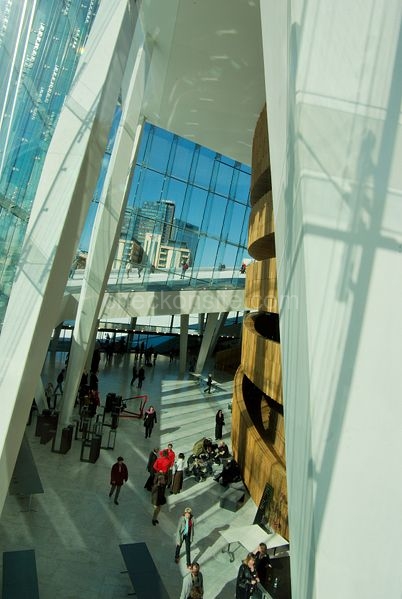
Oslo Opera House
Rate this: Use the stars above to vote, five stars being the highest rating.
Location:
Show on map
Kirsten Flagstads plass 1
Oslo
N 0150
Norway
coordinates:
59.9075394 10.7521820
Building names(s): Oslo Opera House
Architect/Designer: Snøhetta
Images: add an image <== click HereOther Information:
Last update: 3 May, 2011 | Suggested By zoran


(2 votes, average: 3.50 out of 5)
The conceptual basis of the competition and the final building is a combination of three elements, the “Wave Wall, the “Factory” and the “Carpet.”
The Wave Wall
Opera and ballet are young art forms in Norway, art forms that evolve in an international setting. The Bjørvika Peninsula is part of a harbor city, historically the meeting point with the rest of the world. The dividing line between the ground “here” and the water “there” is both a real and a symbolic threshold.
The Factory
The production facilities of the Opera House are realized as a self contained, rationally planned “Factory.” This “Factory” is both functional and flexible which was very important during the planning phase where a number of rooms and room groups were adjusted in collaboration with the end users. These changes have improved the buildings functionality without affecting the architecture.
The Carpet
The competition brief stated that the Opera House should be of high architectural quality and be monumental in it’s expression. To achieve monumentality the architects wanted to make the Opera accessible in the widest possible sense, by laying out a “Carpet” of horizontal and sloping surfaces on top of the building. This “Carpet” has been given an articulated form, related to the cityscape. Monumentality is achieved through horizontal extension and not verticality.
The materials, with their specific weight, color, texture and temperature, have been vital to the design of the building. Snøhetta’s architecture is narrative, it is the materials that form the defining elements of the spaces – it is the meeting of the materials that articulates the architecture.
For the Opera House three main materials were specified at the competition entry. White stone for the “carpet,” timber for the “Wave Wall,” and metal for the “Factory.” As work continued glass was introduced, allowing the underside of the “carpet” to be visible.
The “Carpet” was a collaboration with artists Kristian Blystad, Kalle Grude and Jorunn Sannes. The architects chose the Italian marble, La Facciata, because it retains its brilliance and color even when wet. The surface treatment of the stone, its pattern, cuts and lifts, which create a shadow play, have been designed in close collaboration with the artists.
one unique aspect of this building (designed by the architects Snøhetta) is that, on either side of the foyer, the huge roof comes tapering down like giant ski slopes. And because the opera-house authorities are unencumbered by nannying EU health-and-safety legislation (the Norwegians, you will recall, have stood aloof from all that malarky), they have decided to allow the public to clamber up these granite slopes to the very top of the building, where there are fine views of the fjord and city.
The democratic symbolism of that gesture is itself symbolic of the way in which the public has been involved in this project from the start. And that’s why I’m so keen to tell you about it. It makes such a refreshing contrast to the way that major building projects are mishandled here.
Norwegian architecture firm Snøhetta has won the Mies van der Rohe architecture award for the Norwegian National Opera and Ballet in Oslo (previously featured on AD), the Mies van der Rohe Foundation announced Wednesday in Barcelona.
The price worth 60,000 euros (78,000 dollars) is awarded every two years by the European Union and the Mies van der Rohe Foundation in Barcelona for works completed over the previous two years.