National Aquatics Centre
Rate this: Use the stars above to vote, five stars being the highest rating.
Location:
Show on map
Olympic Green
Beijing
China
coordinates:
39.9914322 116.3842163
Building names(s): National Aquatics Centre / Watercube
Architect/Designer:
PTW Architects / CSCEC / ARUP
architect website:
Other Information:
Completion date: 2008
Function: aquatic centre
getting there: The easiest way is to take the Subway Line 8 (Olympic Special Line) then get off at the Olympic Sports Center Stationbus:
1. Take bus no.510 or 839 and get off at Beichenxi Bridge North Station;
2. Take bus no.386, 407, 656, 660, 689, 740, 753, 836 (fast line), 939, 944 (branch line), 983 or Yuntong113 and get off at Beichen Bridge West Station;
3. Take bus no.328, 379, 419, 425, 484, 518, 628, 751, 836, 851, 913, 949, 963 or Yuntong 110 and get off at Wali Nankou Station.
Entrance Fee: CNY 50 (water park only) | CNY 200
Opening Hours Water Cube: 09:00am-7:00pm (Monday-Thursday) | 09:00am-5:00pm (Friday-Sunday)
Innovative Structural solution:
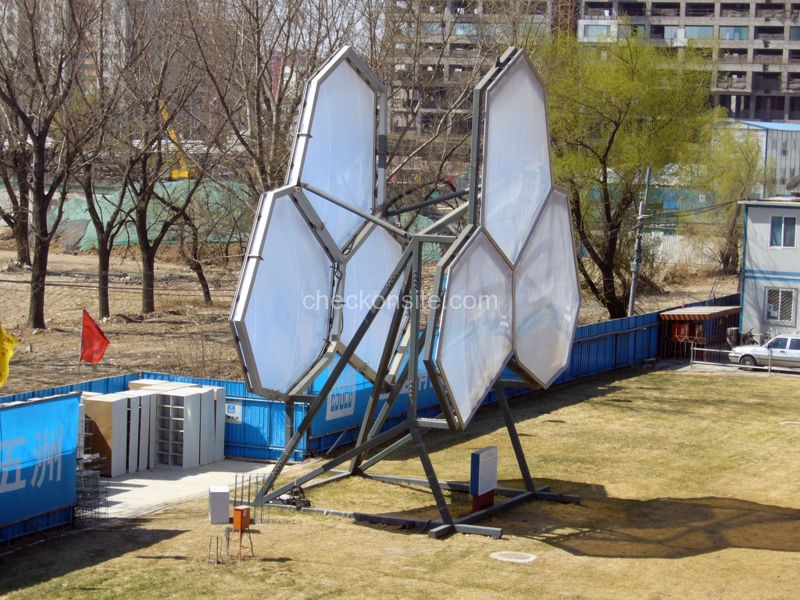
The building’s skin, made from an innovative and lightweight transparent “teflon”, ETFE, has been designed to react specifically to lighting and projection.
The structure is a simple steel space-frame consisting of two parts; the internal structure and the face structure that forms the actual roof and ceiling and accepts the ETFE pillow cladding.
“Our “Watercube” concept is a simple and concise square form that ultimately uses the water bubble theory to create the structure and building cladding, and which makes the design so unique.” Andrew Frost, Director, PTW.
The design is based on a common natural pattern, the most effective sub-division of three dimensional space –the fundamental arrangement of organic cells and the natural formation of soap bubbles.
Total Area: 70,000 square meters
Total seating capacity: 17,000
Last update: 29 June, 2011 | Suggested By LT

(7 votes, average: 4.14 out of 5)
(2 votes, average: 4.50 out of 5)
On Sunday 8th August – the two year anniversary of the start of the Beijing Olympics – the Water Cube was reopened to the public as Asia’s largest indoor water park. Sporting seven-storey slides, a wave pool, a water bar, rides entitled Aqualoop, Ridehouse, Bullet Bowl and Speed Slide, whirlpools and ‘deep-sea tornados’ the 77,000 sq ft complex has already been a hit with the waiting masses. There’s always a catch however, and with the Water Cube it’s a financial issue. In a city where the minimum wage is 960 yuan per month (€107), at 200 yuan for adults and 160 yuan for children to enter the park, it seems the emphasis is on attracting tourists rather than locals. For this price visitors can gain entrance to the park complex, which also includes shopping arcades, cafes and performance stages, whereas a much more feasible 50/30 yuan remains the entrance fee to the water park alone.
The structure of the WATERCUBE is based on a unique lightweight construction, developed by China State Construction Design International (CCDI), PTW Architects, and ARUP, and derived from the structure of water bubbles in the state of aggregation found in foam.
Behind the totally random appearance hides a strict geometry that can be found in natural systems like crystals, cells and molecular structures – the most efficient subdivision of three-dimensional space with equally sized cells.
The transparency and apparent randomness is equally transposed into the inner and outer building-skins, made of inflated ETFE cushions.
The National Swimming Center for the 2008 Olympics is an absolutely cool building. Known as the “Watercube,” PTW’s design is a basic box, juxtaposed with an organic “bubble” structure that makes up the building cladding. The bubbles are both organic (in form) and highly-scientific, constructed based on actual arrangement of organic cells and the natural formation of soap bubbles. This novel building is an energy saver as well, 90% of the solar energy falling on the building is trapped within the structural zone and is used to heat the pools and the interior area.