Museum and Park Kalkriese


(2 vote, 80.00% worth checking out)
Location:
Show on map & checkout the other sites nearby
Venner Straße 69
Osnabrück
D - 49565 Bramsche-Kalkriese
Germany
coordinates: 52.4062691,8.1296043
open coordinates in google maps
open coordinates in apple map
Building names(s): Museum and Park Kalkriese
Architect/Designer: Gigon & Guyer
architect website:
Images:
Show on map & checkout the other sites nearby Venner Straße 69
Osnabrück
D - 49565 Bramsche-Kalkriese
Germany
coordinates: 52.4062691,8.1296043
open coordinates in google maps
open coordinates in apple map
Building names(s): Museum and Park Kalkriese
Architect/Designer: Gigon & Guyer
architect website:
Images:
Completion date: 2002
function(s): museum
website: www.kalkriese-varusschlacht.de
opening hours: varies according to season and exhibition (check website for details)
Open daily 9:00 am – 6:00 pm
Saturdays 9:00 – 8:00 pm.
Guided tours (permanent exhibition) take place daily at 3:00 pm.
costs:Euro 9 : varies according to season and exhibition (check website for details)
getting there:
Take a train to Osnabrück central station and continue by bus. (bus timetable available from website)
suggested on: 4 June 2009 |
Suggested By LT
1 comment/review
The Museum about it's architecture says:
Jun 4, 2009
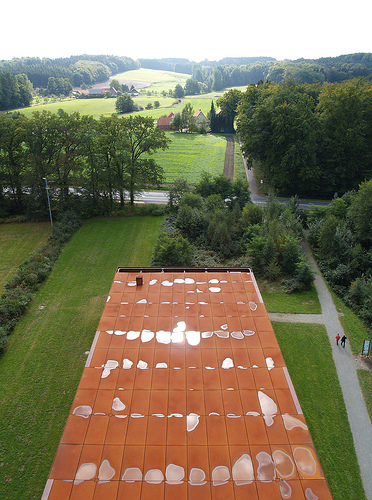
The architecture of the Museum by the architects’ office of Anette Gigon and Mike Guyer, Zurich, is without doubt an architectonic piece of art. Nevertheless, it does not bring itself into focus, but completely subordinates itself to the local landscape and its history. One could think it translates the spirit of the scenery into a clear form.
The compact cube is covered with steel sheets, their top layer covered with rust. This effect of natural corrosion and the building’s russet colour lets it fit into the surrounding landscape like an organism and thereby creates a connection to its history. The mighty steel sheets express a strength that is in no way inferior to the forces which developed in the fray 2000 years ago. – Or does the building, which seems to snuggle close to the earth, arched like an animal, brace itself against the force of the charging Roman Army which was on the verge of annexing a new province?
An interpretation is neither easy and explicit nor mandatory. One who gets involved in the design vocabulary of the buildings of the Museum and Park might find another access to the distant history of the Varus Battle 2000 year ago.
The architectonic elements in the park of the museum, – the three pavilions, the stelae of the rampart and the “Roman Path” which begins in front of the museum – want to be ‘conquered’ individually by the visitor. The tower of the museum standing 40 metres high provides a good opportunity for a first overall view …