Multi-Faith Centre University of Toronto


(2 vote, 70.00% worth checking out)
Location:
Show on map & checkout the other sites nearby
569 Spadina Ave.
(located in the Koffler Institute)
Toronto
ON M5S 2J7
Canada
coordinates: 43.6608391,-79.4009171
open coordinates in google maps
open coordinates in apple map
Building names(s): Multi-Faith Centre University of Toronto
Architect/Designer: Moriyama & Teshima Architects
architect website: www.mtarch.com
Images: add an image <== click Here
Show on map & checkout the other sites nearby 569 Spadina Ave.
(located in the Koffler Institute)
Toronto
ON M5S 2J7
Canada
coordinates: 43.6608391,-79.4009171
open coordinates in google maps
open coordinates in apple map
Building names(s): Multi-Faith Centre University of Toronto
Architect/Designer: Moriyama & Teshima Architects
architect website: www.mtarch.com
Images: add an image <== click Here
Completion date: March 2007
function(s): religious
Getting there by TTC:
1)Go to Spadina Subway Station on the Bloor-Danforth Line
2)Catch the streetcar from inside Spadina Station
3)Exit at Willcocks Street and exit onto the east side of Spadina
suggested on: 10 June 2009 |
Suggested By LT
2 comments/reviews
Camille Chami says:
Jun 10, 2009
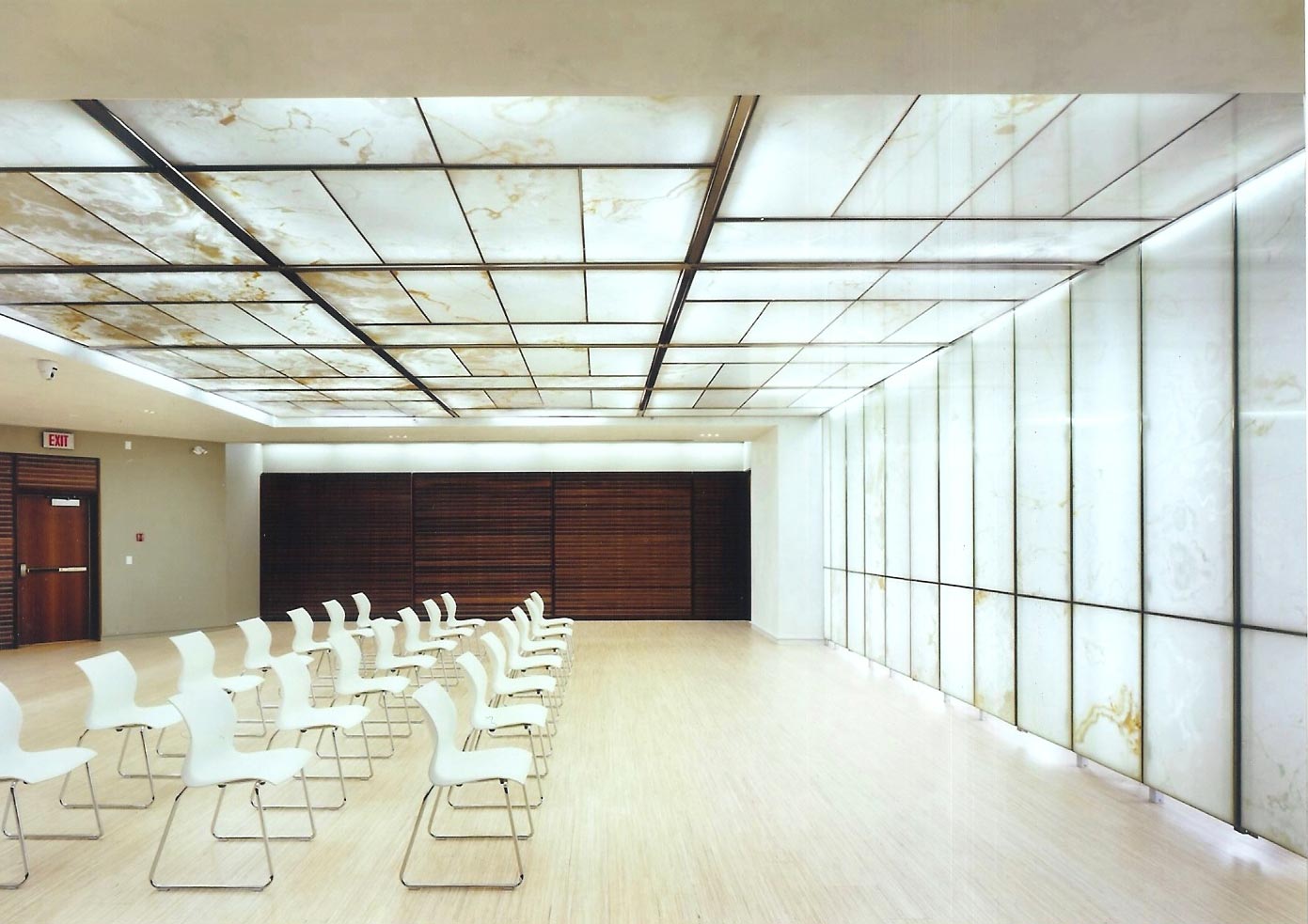
The space was crafted within the constraints of an existing building, with selective alterations to existing interior spaces to meet both programming and budget needs. The design comprises: a large congregational space, smaller quiet rooms and a meditation room, ablution facilities, a multi-purpose room with adjoining kitchen facilities, meeting areas, offices and a resource centre.
The main hall glows with serenity, and conveys a deep sense of calm and quiet contemplation. The quiet drip of water from a living wall in the meditation room creates an immediate connection with the living world, and a vivid backdrop against which to consider links between all forms of creation. The quiet room (used by bereavement groups and yoga classes) and the family room signal the University’s invitation to all its members to seek refuge and opportunities for contemplation. The materials chosen for the finishes are intentionally local in nature, underlining the hope for a distinctly Canadian response to the challenges of religious pluralism.
The new Multifaith Centre is worthy of recognition because it conquers the paradox, evoking no particular religion or faith, but speaking to transcendental qualities of spirituality, fellowship and peace. The Centre provides a home for multifaith study that will encourage expression of different and dissenting views. It’s design offers one of the most promising opportunities for creating a framework within which religious pluralism can be discussed, debated and understood. That architecture can inspire civility and understanding between people, no matter their faith, is a powerful thing. Religion may often divide, but the Multifaith centre gathers and affirms.
Sean Bryen says:
Jun 10, 2009
… While keeping to the University’s secular mandate, Moriyama & Teshima Architects were to create a refuge and place of worship which was programmatically and liturgically flexible enough to accommodate all spiritualities; celebrating the creeds of the roughly 30 religious organisations on campus without bias, and providing a forum for debate.
Implicitly, part of its mission was to manifest cultural and moral relativism in built form – an endeavour perhaps condemned to the necessary vagueness which lies at the heart of relativism itself. Nevertheless, the Multifaith Centre has succeeded in creating a physical common ground between religious faiths and secularism where none existed before. In the first month of operation, up to 60 events were hosted in the centre, which was constructed on a meagre budget (as far as university construction budgets go) of Canadian $1.43m.
The hall is removed from the rest of the Koffler Centre, creating a transition between the secular and religious. The onyx wall panels open to reveal alcoves for the storage of liturgical artefacts and scriptures of different religions. Ablution facilities are located away from washrooms, with running water at a constant temperature, and there are provisions for gender-segregated worship.
The project employs the shared metaphor of enlightenment; its most salient feature being the backlit glass-laminated onyx ceiling and eastern wall of the prayer hall, which bathe worshippers in a diffuse white light. It is a temple to the coexistence and discussion of moderate religions.
The Multifaith Centre necessarily frames fundamental commonalities and flattens extremes, much in the way that the pure geometry of the International style has created a shared architectural language for the developed world, sometimes at the expense of local tradition and sensitivity to context, but in general for the sake of harmony and unison. The onyx wall and ceiling for example, which holds up a tonne of onyx at 39kg per square metre, are broken up into a pattern of panels inspired by numerologies sacred to the major religions. Fused together into one grid, this is hard to read and somewhat tokenistic. This and other examples of a lack of semantic clarity or specificity in the project’s architectural expression may simply be a reflection of the irreconcilability of certain beliefs.
But rarely is one idea simply replaced with another. More often when ideas must be reconciled, they are synthesized into something new altogether; and when the secular process of globalisation collides with a multitude of conflicting belief systems, a new culture and architecture are born. This seems to be sensitively reflected in the Multifaith Centre. It is in fact Moriyama & Teshima’s distinctly Canadian take on what Australians would call multiculturalism, and on the complex value-laden issue of national identity. The architects have had to consider – and have helped shape the public’s attitudes towards – these issues before, such as in designing the Canadian War Museum in Ottawa with Griffiths Rankin Cook Architects.
In this very American century, Canada, like Australia, is self-consciously at the periphery. Like Australia, Canada lacks a homogenous sense of identity, pensive about being absorbed by the textureless international culture of a globalised world; about one day becoming indistinguishable from the US. If America was baptised in the blaze of a revolution, Canada and Australia, as the hinterland and outback of the Commonwealth respectively, have only recently grown into adolescence. In both countries one finds an uncertain tension between Western architectural heritage and Aboriginal ways of relating to the land. Both face the challenge of asserting a national identity while having been a frontier colony, and now a ‘land of immigrants’– itself a contentious phrase on stolen land. Roughly half the population of Toronto in fact is foreign-born, making it one of the most culturally diverse cities in the world.
Yet despite the blurring of borders and the difficulty of definition, it is possible to speak of a Canadian architecture, just as one can meaningfully describe certain architecture to be Australian. Both Canada and Australia are past the stage of imitation, or of self-definition through the erection of nationalised romantic monuments. Architects in both countries, perhaps sparked by the increased awareness of environmentalism and the rights of Aborigines and recent immigrants, are reconsidering their country’s vernacular and the geography with which it interacts. Even the ravines of Toronto demand a thoughtful reconsideration of architectural and urban design, and make the city unique within Canada.
The developing Canadian tradition has the pleasure of being marginal but not provincial, internationally informed but not derivative, newly confident in having conquered the frontiers and yet humble. (Canada is yet to produce a ‘star’ architect like Gehry or Koolhaas.) It recognises what Northrop Frye described as “the humanly undigested” in the Canadian landscape, but is no longer intimidated by it. Instead it seeks to provide an honest response to both the literal wilderness and the ideological wilderness of the post-modern city.
The prayer hall of Moriyama & Teshima’s Multifaith Centre is a locus point where these cultural trajectories meet. Its muted architectural palette speaks of different things to different visitors; but to all, it is a serene retreat, reverent rather than oppressive, minimal but human rather than ascetic. Occasionally, dripping water can be heard from the green wall in the meditation room. The centre, while accommodating all faiths, does not evoke any one in particular