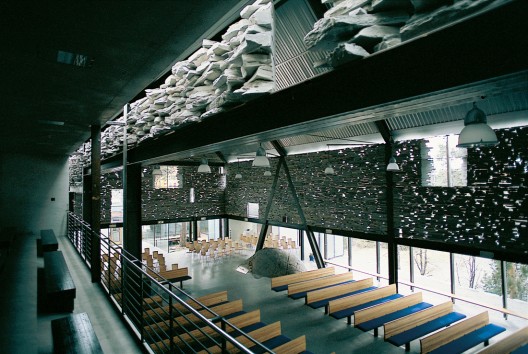
Mortensrud Church


(4 vote, 75.00% worth checking out)
Location:
Show on map & checkout the other sites nearby
Helga Vaneks vei 15
Oslo
NO-1215
Norway
coordinates: 59.8470573,10.8319721
open coordinates in google maps
open coordinates in apple map
Building names(s): Mortensrud Church
Architect/Designer: Jensen & Skodvin Arkitektkontor
architect website:
Images: add an image <== click Here
Show on map & checkout the other sites nearby Helga Vaneks vei 15
Oslo
NO-1215
Norway
coordinates: 59.8470573,10.8319721
open coordinates in google maps
open coordinates in apple map
Building names(s): Mortensrud Church
Architect/Designer: Jensen & Skodvin Arkitektkontor
architect website:
Images: add an image <== click Here
Completion date: 2002
function(s): church, religious
Budget: 5.500.000 EURO (US $8.42 millions)
Constructed Area: 2.200 sqm
church webite: www.mortensrud.no
for architectural plans visit archdaily website
suggested on: 24 April 2009 |
Suggested By zoran
2 comments/reviews
archdaily says:
Apr 24, 2009
The budget was very tight, and the price per square meter equals that of social housing in Oslo. To get this building realized we had to use every possibility we could think of to get more out of less, economically speaking. This was achieved mainly by avoiding conventional “proprietary” systems for facades, structures, walls, floors etc. Rather we used very basic methods and techniques and surprisingly found out, again and again, that not only was it cheaper, it also gave us a far greater architectural freedom.
specifier says:
Apr 24, 2009
The main structure is a real piece of topsy-turvy, gravity defying work. Reversing the general practice of heavy materials on the bottom supporting increasingly lighter materials towards the top, the Mortensrud Church consists of a steel framework with a heavy stone wall uneasily supported above transparent glass walls. A glass façade 90-160cm off the stone wall defines a narrow gallery around the church room. The glass affords a visual connection with the outside activity, while, especially at pew level, sheltered by the stone, the glass allows interior and exterior, God and man, to flow together without glare or unease. The stones are stacked without mortar, creating little, intermittent holes through which light enters the hall like tiny glimmering stars. Otherwise, rectangular windows appear arbitrarily and asymmetrically through the stone. Of the stone walls, there is one even side, and one uneven as standard. The uneven exterior of the internal stone wall is exposed to the outside through the glass façade of the three sides of the church. The stone wall is stiffened horizontally by steel plates, 4mm x 250mm, that span between the columns, inserted into the wall every metre. These plates stiffen the wall only when the weight of the wall itself is added to this structure. The glass facades are stiffened with “propels” made from steel plates that are inserted into the vertical joints between the glass panes, and to the horizontal steel plates in the stone wall.
The architects talk of a tension between the wish to create a ‘silent’ self-referring space, and the obstacles limiting that possibility. Ultimately the obstacles were given due credence. The architects wanted, engendered in the very structure, a deliberate ploy to disrupt the conventional view of a church as a silent, unconnected, introspective place. This church is extroverted; connected to the multitudes of the surrounding nature. It’s fragmented, complex, and the architects relish the overall realisation that it’s impossible to photograph the whole building, or interior, in one shot. The whole building allows nature to leak inside, so the architects, Mr. Wright, have certainly been creative.