MAXXI
Rate this: Use the stars above to vote, five stars being the highest rating.
Location:
Show on map
Via Guido Reni, 2f
Rome
00196
Italy
coordinates:
41.9284935 12.4665108
Building names(s): MAXXI / Museo nazionale delle arti del XXI secolo
Architect/Designer: Zaha Hadid
Images: add an image <== click HereOther Information:
Completion date: opening scheduled for early 2010
Function:
website: www.fondazionemaxxi.itgetting there:
bus n. 19, 53, 217, 225, 910
Metro A to Flaminio Station_tram n. 2 to the Apollodoro stop
Last modified: 10 August, 2010 | Suggested By LT

(6 votes, average: 4.00 out of 5)
(4 votes, average: 4.50 out of 5)
This week MAXXI previewed to rapturous fanfare from a myriad of press. Situated in a somewhat unassuming street away from the centre of Rome’s cultural hubbub, Hadid’s MAXXI lurks like a giant behind a tree, or behind a traditional facade and a steel gate as the case may be.
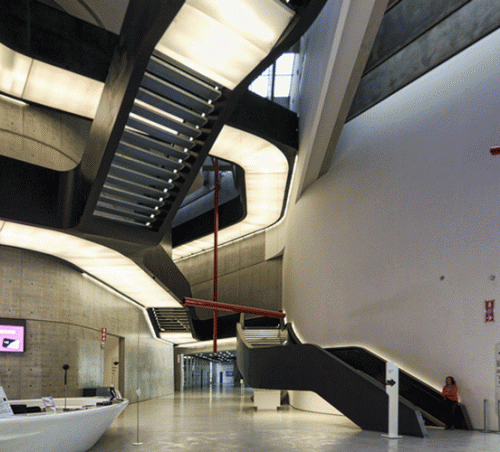
From within, the monumental scale of the 30,000 sq m building is instantly apparent yet cleverly broken up in the grand chamber entrance by the sinuous curves of the monochromatic stairways. With spectacle that would force a crick in anyone’s neck, luminous criss-crossing stairways creating platforms and vistas, guide the eye to the heavens.
Moving throughout the building which is to house two institutions: MAXXI Arte and MAXXI Architecture, spaces are found through almost labyrinthine paths branching off from the stair wells. While some of the champagne-fuelled journalists proclaimed the building offered ‘too much!’ in terms of space, perhaps they will change their views when over 350 contemporary art exhibits and 75,000 architectural drawings currently lying in wait are on display. Judging by the mammoth-sized lift offering safe passage to the upper chamber for the same, it is clear that many of these exhibits will require a great deal of space. So too will the auditorium, library, bookshop, cafeteria, futher exhibition space and laboratories, for that matter.
While the cathedral-like halls are grand, they are at once bereft of the colour that would make them imposing. The result is a dramatic yet respectfully sedate canvas for the exhibits. But is it so for Rome?
Hadid made a clear attempt to integrate the museum with the fabric of Rome, maintaining a Romanesque frontage. However this only forms a barrier if viewed from straight on. I happened upon the MAXXI the night before the preview, on a bus back to my hotel. I knew instantly what the gently sloped block appearing over the precipice of the traditional base must be. A distinct Hadid aura despite differing from the majority of her works. From the other vantage point to the right, a perforated steel gate offers passers by a blatant tease of what lies beyond. But I can’t help wondering what sort of view those living in the buildings overlooking MAXXI to the rear have, and if they approve.
Nevertheless, the resounding applause from the predominantly Italian press within as Hadid said her thanks, suggested the MAXXI would be considered an asset to Rome. In thanking her partner, Patrik Schumacher, whom she had ‘spent many nights in the office’ working on the designs for MAXXI, Hadid added praise to the Italian team, the support of the Romans and told of the inspiration their city had awarded her: “I would also like to thank the contractors who I think really were tremendously supportive in making sure this building went extremely well and also kept the fluidity of the bureaucracy running. But talking about fluidity it was very important and it was very symbolic for Rome to create a new design plan, to create a new area, a canvas for art, and for the urbanism of Rome…also I took from Rome the position of layering, the idea that the city is very old, layers that have been here for many years – this project is done also like a layering of many spaces that hopefully can give free choice, freedom to those who store art.”