Maggie’s Centre Fifearc
Rate this: Use the stars above to vote, five stars being the highest rating.
Location:
Show on map
Victoria Hospital
Hayfield Road
Kirkcaldy
KY2 5AH
United Kingdom
coordinates:
56.1241722 -3.1596744
Building names(s): Maggie’s Centre Fifearc / Cancer Caring Centres
Architect/Designer: Zaha Hadid
Images: add an image <== click HereOther Information:
Completion date: 2006
Function: cancer center
website: www.maggiescentres.orgOther Maggie’s Centres:
you might also want to checkout the Maggie’s Center Gartnavel by OMA
Last update: 4 October, 2011 | Suggested By LT

(5 votes, average: 4.00 out of 5)
(4 votes, average: 4.50 out of 5)
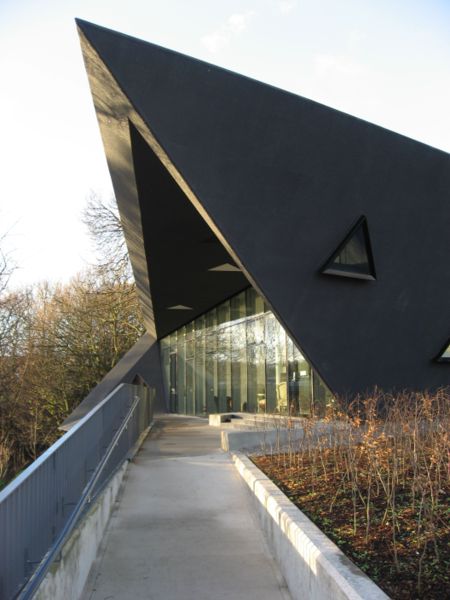
Hadid has placed her building on the very cusp of the pit where it effectively serves as a threshold between the hospital and this little pocket of wilderness. The building’s form has a strong directionality — in essence, it is a continuous plate that runs along the edge of the hollow, performing a loop the loop en route. As a floor surface, the plate is in concrete. Where it becomes wall and roof it reverts to a steel framed structure. Originally it was intended that these faces would be clad externally in corten steel. However, when the tenders came back it proved a prohibitively expensive choice. Instead, a black liquid polyurethane coating has been employed — a standard roofing product which has been tweaked through the introduction of a silicone carbide grit in the last of the four specified coats. This addition makes the material sparkle in the light, articulating the building’s faceted geometry. In good weather I don’t doubt it looks every bit as jewel-like as in the photographs. In the overcast conditions that I experienced — hardly uncharacteristic of these parts — the effect was less enticing. The building looked rather as if it had been folded up from the asphalt of the car park. That said, the view down from the wards of the adjacent tower is a crucial one and is much enhanced by the fact that the choice of this liquid application has enabled a completely seamless transition between wall and roof planes.
The loop the loop gesture sets up two approaches to the building, one from the east and one from the west, which ultimately deliver visitors to the same lobby space. The relative status of these routes does not feel altogether resolved. Because of its relationship to the hospital’s front door, the westerly approach will undoubtedly be the more trafficked. However, in keeping with the idea of the centre as an autonomous unit, Hadid expresses the opposing route as the principal way in. The door nearest the hospital is in fact very downplayed indeed. To find it, you have to track down a narrow passage between the fully glazed north elevation and a freestanding wall which has been sited to offer some measure of screening from the carpark. Rising in height from ground to roof level, this plane ultimately returns into the building to establish a dead end and it is here, set flush within the glass frontage, that you discover the door. For the uninitiated, I fear it makes for an uncomfortably confusing first encounter.
Far better, then, to access the building by trekking round to its east side. Doing so, you discover that the shallow concrete plinth on which the building sits has been extended like an arm around the edge of the hollow. Along its 20m length, the top surface remains level, establishing a datum against which the fall of the adjacent carpark is registered. As it extends away from the building the plinth begins to morph until eventually it consists of no more than two waist high walls delimiting the sides of the approach path.
It is a supremely well handled device answering desires that are ostensibly in opposition — on the one hand the goal of inflating the scale of a small building by connecting it to its surrounding landscape, on the other the aim that the building might be understood as a retreat from its context.
The short journey down this path has been meticulously composed — clearly the product of extensive testing with models. Tracking round the edge of the pit, the route climbs, cranks, slips beneath a prow-like roof overhang, widens into a terrace that runs along the fully glazed south elevation and finally juts free of the hill in a dramatic cantilever. Along the way your awareness of the hospital quite evaporates and you find yourself placed squarely within the poetic world of the overgrown hollow.
In contrast to the dark and sharp-edged carapace that is the building’s exterior, the interior is curvaceous, filled with light and blessed with a magnificent view of the tops of the trees that grow below it. It also reveals that, given a rich social programme to work with, Hadid is a far more responsive architect than the brilliant formalist that she is often dismissed as.
There is no designated reception area but rather it is assumed that the modest scale and open plan will enable staff members to spot newcomers as they arrive. Indeed, although it is compartmentalised, the interior reads very much as one volume. Wherever you are, you remain conscious of the all-encompassing span of the roof. Pitching up from west to east, it enables Hadid to establish spaces of dramatically varying levels of intimacy within the same volume. A squadron of triangular light sources — some skylights, others fluorescent fittings — sweeps across the whole surface and down the canted walls. It is a unifying device that speaks of the influence that Russian Constructivism continues to exert on Hadid’s vocabulary. In particular, it brings to mind the field of apertures that punctuate the walls of the Melnikov house in Moscow.
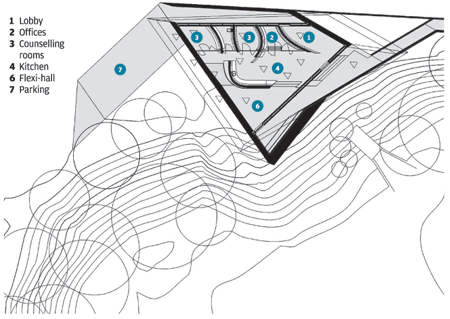
The smaller spaces — an office and counselling rooms — are ranged along the north elevation, divided by walls that billow expressively in plan. Superscaled pivoting doors can close these areas off as necessary but ordinarily they will be left open, enabling views from one side of the building to the other.
The communal area is divided into two distinct territories by a curved wall in the centre of the plan. The concave side that it presents to anyone entering the centre supports a kitchen. A large freestanding table is to be sited within its embrace, establishing a focus for the life of the building. The 60 to 70 visitors the centre expects to receive each day will be able to get tea and coffee here, but the area will also host a regular programme of nutrition classes.
A slight drop in floor level defines the space on the far side of the curved wall as a distinct territory. You can reach it either by a set of steps which draws you down past the glazed south elevation, or by a ramp which tracks around the convex face of the curved wall — a surface that has been used to support the centre’s library. It is designated as a flexible space, left open to accommodate exercise classes and opening directly onto the terrace.
Standing here, watching the myriad light sources model this effortlessly fluid concoction, one has no doubt that this is architecture of a very high order indeed. But perhaps Hadid’s greatest success is that for all her astounding formal invention, she still manages to establish a space of a fundamentally domestic character. Indeed, one can readily imagine a family taking up residence here without feeling the need to change a thing.
That said, from the outside, the building is unquestionably a tougher proposition than the previous Maggie’s Centres. Even Gehry seemingly felt the need to make an explicitly “friendly” building and arguably ended up with something on the wrong side of cute as a consequence. For many, entering Maggie’s Fife for the first time will demand a real level of courage, but then, instilling courage in its users is the building’s very purpose.
read more at bdonline