London Development Agency
Rate this: Use the stars above to vote, five stars being the highest rating.
Location:
Show on map
Palestra
197 Blackfriars Rd
London
Southwark SE1 8AA
United Kingdom
coordinates:
51.5038605 -0.1043272
Building names(s): London Development Agency / The Palestra
Architect/Designer:
Will Alsop
architect website:
Other Information:
Completion date: October 2006
Function: commercial
website: www.lda.gov.ukarea: 5,100 m2
awards:
- RIBA Regional Award (London) (2007)
- Private Eye magazine Award for the Worst New Building (2006)
Last update: 16 September, 2010 | Suggested By LT


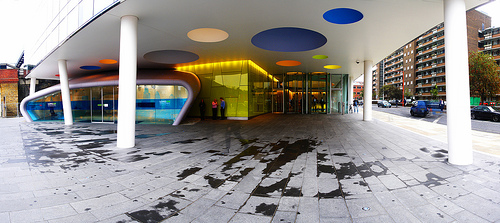
Will Alsop’s pods invite metaphors, it’s what they’re there for. Irregular interruptions into regular worlds, they reach out to our imagination and form an emotional bridge to the building. Palestra, SMC Alsop’s new spec-built office development in an up-and-coming corner of Southwark, has hatched a fine example. It’s cute and curvy, nestling beneath the cantilevered upper floors. Could it be a secret grotto? A shelter for travelling Clangers? The business end of a Teletubbies vacuum cleaner?
But to the building’s new tenants, the metaphors are clear enough. The London Development Agency has signed up for two floors of Palestra, and also taken the pod and half the ground floor space. Its brief to the interior design team from Sheppard Robson was to transform the pod into reception-cum-exhibition space: the finished pod not only invites Londoners’ curiosity, but invites them inside.
Drop-in visitors can use the touch screen displays about developments in London and the plans for the 2012 Olympics, or take away brochures. Visitors with an appointment are greeted by a sleek white and glass reception desk, then guided through to the lift cores or the ground floor conference rooms by a curving GRP wall shaped like the crest of a breaking wave. Deceptively spacious, the pod can welcome 70 guests at evening events.
So the pod is a squashed TV screen displaying what’s going on inside, a gramophone horn amplifying its message, the public friendly face of a faceless government agency. In fact, pod and tenant are a pretty good fit. When you consider that the pod was originally conceived by the architect and developer as retail space — selling Kit Kats and sandwiches? laptops and light fittings? — you realise just how good.
Palestra’s pod and architecture were about reconciling the developer’s need to risk-proof its £160 million investment with a bold design that would awaken the commercial potential of an untested location. “It’s about the intersection of various bland corporate issues about property development and the Alsop approach to life,” says Neil Grey, who headed the team at project manager CB Richard Ellis. “The client [Mallory Clifford of Blackfriars Investments] has always been attracted to working with people like Will. But the ground rules of this industry are about risk. So we had to ask ourselves, would lawyers be happy here? Would accountants?”
The pod is a squashed TV screen displaying what’s going on inside, the public friendly face of a faceless agency.
To the world at large, Palestra is a triple-decker sandwich gone slightly askew, held together by some cocktail-stick pilotti. Its cellophane wrapper is a Permastaleese curtain-walling system with fritted panels in grey and black, and acid yellow panels in the slab edges. But internally, it’s built to a standard developers’ spec, with rectilinear floorplates around three cores. The most surprising thing about the empty floor plates is how unsurprising they are, that the building’s playful geometries aren’t in some way carried inside.
We wanted to do something that would appeal to the letting market but also stand out so that it gives the building a visual identity. Often the commercial developer’s instinct is to maximise the lettable space, so the architecture becomes a very thin skin that’s wrapped around it. But Neil Grey at CB Richard Ellis was one of the driving forces in saying [to the agents and funders] “listen to these guys.”
After we got planning permission, the letting agents became involved, and we had to revisit the interior. Agents tend to want more of what has worked before, while as architects we want to explore the boundaries. But we added a third core, moved the retail space from the side elevation to the front by creating the pod, changed the shape of the entrance and the façade.
The black and grey fritting takes up no more than a third of every glazing panel so that it’s not too noticeable inside, then we created a random pattern with the yellow in the slab edges.
The covered courtyard next to the pod is highly visible and will have a public use, so were keen to jazz it up with the coloured circular insets in the soffit.
Because we’ll have just two tenants, the LDA and Transport for London, there will be consistency in the choice of lights and blinds. The lease requires that everyone chooses the same roller blinds. If they’re all pulled down, or partially down, it will add to the patterning of the building.
The client had to walk a narrow line on providing a building that suits modern office requirements and sustainability issues. It is a fully air- conditioned, sealed glass envelope that couldn’t be designed today. But the client took the decision to meet Part L 2002, even though it wasn’t in force at the time. It didn’t want to have the last building on the block that didn’t comply.
When agents and people in the property industry have been inside, they say “it works, it’s sensible”. And I say, what
did you expect?
The building consists of a series of three distinct interconnected volumes. The tilted ground-scraping base slab lifts up towards the west, cantilevering six metres above the pavement to create a dynamic building entrance and public space.
The upper and lower boxes are differentiated by form and colour. The tilted lower box is clad in a structurally bonded double glazed curtain walling system. Each glazed panel has a colour printed full height across one-third the width of the glazing. The combined effect viewed externally is one of a patchwork of colour, giving scale and texture to the facade. Internally, the appearance of any colour within the office area is minimized.
Between the upper and lower office boxes is a recessed office block that fronts onto an external terrace area on the north, east and south elevations. This open amenity is protected from the wind and driving rain by an extension of the office glazing system that provides a glass balustrade to the perimeter of the terrace.
Renewable energy generated by a roof-installed system—a combination of a 63 kW photovoltaic array and 14 wind turbines producing 21 kWp—will provide electricity to the LDA’s three floors, specifically for the computer and data rooms and the IT closet. The combined technologies will generate 3,397,000kWh of renewable electricity and reduce CO2 emissions by 3,300 tons during the building’s lifetime. The project was funded and implemented by the London Climate Change Agency, which was set up by London’s mayor in 2006 to tackle climate change by promoting renewable and sustainable energy.