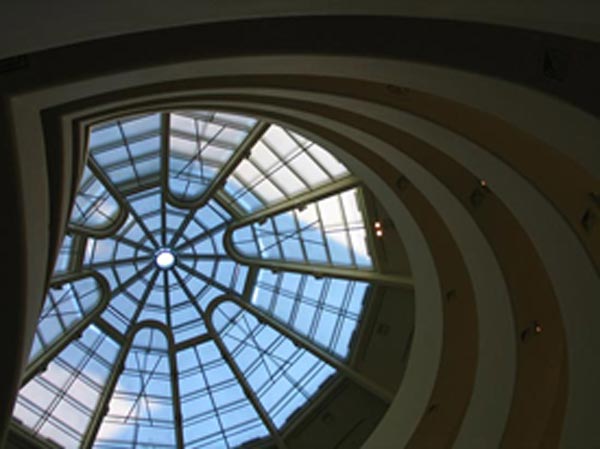
Guggenheim Museum New York
Rate this: Use the stars above to vote, five stars being the highest rating.
Location:
Show on map
1071 Fifth Avenue
(at 89th Street) NY 10128 0173
New York
USA
coordinates:
40.7829208 -73.9589920
Building names(s): Guggenheim Museum New York / Solomon R. Guggenheim Museum
Architect/Designer: Frank Lloyd Wright
Images: add an image <== click HereOther Information:
Completion date: 1959
Function: gallery
Website: www.guggenheim.orgopening hours:
Monday-Friday 10:00am-5:45pm (closed Thursday)
Saturday: 10:00am-7:45pm
tip: On Saturday evenings beginning at 5:45 pm the museum hosts Pay What You Wish, in which admission is by donation. The last tickets are issued at 7:15 pm. These tickets are not free and can not be purchased in advance. The museum closes at 7:45 pm Saturdays.
admission cost: $18.00
Last modified: 3 May, 2011 | Suggested By LT

(9 votes, average: 4.33 out of 5)

Originally called “The Museum of Non-Objective Painting,” the Guggenheim was founded to showcase avant-garde art by early modernists such as Rudolf Bauer, Hilla Rebay, Wassily Kandinsky and Piet Mondrian. It moved to its present location, at the corners of 89th Street and Fifth Avenue (overlooking Central Park), in 1959, when Frank Lloyd Wright’s design for the site was completed.
The distinctive building, Wright’s last major work, instantly polarized architecture critics upon completion,though today it is widely revered. From the street, the building looks approximately like a white ribbon curled into a cylindrical stack, slightly wider at the top than the bottom. Its appearance is in sharp contrast to the more typically boxy Manhattan buildings that surround it, a fact relished by Wright who claimed that his museum would make the nearby Metropolitan Museum of Art “look like a Protestant barn.”
read more on wikipedia.org website
Another Building which uses this top down method of circulation is Tadao Ando’s Omote Sando Hills Tokyo.
The Guggenheim Museum is an inverted ziggurat (a stepped or winding pyramidal temple of Babylonian origin) where the path through the museum is from the top down. Starting at the top of the building (via elevator), the visitor coils their way downward though the exhibition on the gentle slope of a continuous ramp.