Greater London Authority Building


(4 vote, 80.00% worth checking out)
Location:
Show on map & checkout the other sites nearby
The Queen's Walk
More London
London
SE1 2AA
United Kingdom
coordinates: 51.5049362,-0.0786638
open coordinates in google maps
open coordinates in apple map
Building names(s): Greater London Authority Building / City Hall
Architect/Designer: Foster & Partners
Images: add an image <== click Here
Show on map & checkout the other sites nearby The Queen's Walk
More London
London
SE1 2AA
United Kingdom
coordinates: 51.5049362,-0.0786638
open coordinates in google maps
open coordinates in apple map
Building names(s): Greater London Authority Building / City Hall
Architect/Designer: Foster & Partners
Images: add an image <== click Here
Completion date: 2002
function(s): civic, government
website: www.london.gov.uk
opening hours (to public): Monday to Friday from 8am to 8pm (see website for more details)
getting there:
- Underground and rail stations:
- London Bridge (Jubilee and Northern lines and mainline station)
- Tower Hill (Circle and District lines)
- Tower Gateway (Docklands Light Railway)
- Buses: 42, 47, 78, 381, RV1
- River services: to London Bridge City Pier, also Tower Millennium Pier and St Katharine’s Pier – see Transport for London – river services
- Bicycle: bicycle racks are available at City Hall, on the south side of the building by Potters Fields Park.
suggested on: 23 March 2009 |
Suggested By LT
1 comment/review
GLA says:
Mar 23, 2009
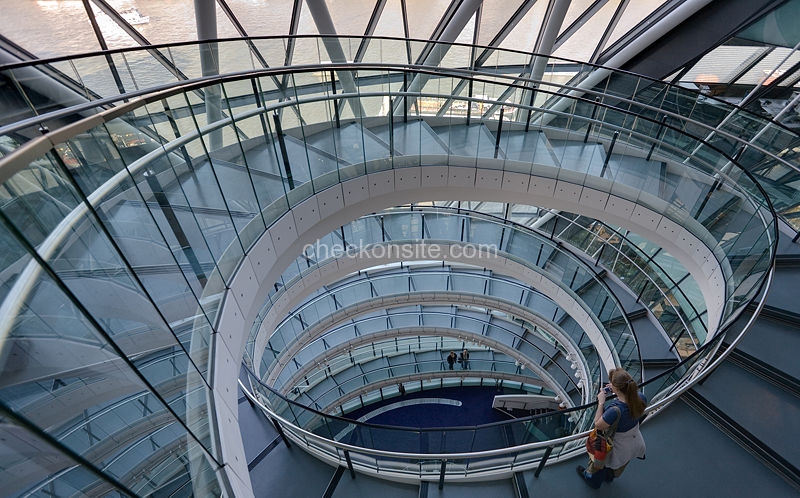
The built form of City Hall is a distinctive glass globe, with a purpose built assembly chamber and offices for GLA staff. The building is 45 metres high, with 185,000 sq ft (gross) of floor space spread over 10 floors.
In conventional terms, the building has no front or back: its shape is derived from a geometrically modified sphere. This hybrid form is designed to minimise the surface area exposed to direct sunlight. The design incorporates as a number of features designed to make the building as green as possible.
The energy strategy for City Hall enables it to run on a quarter of the energy consumed by a typical high specification office building. This is achieved not only through the use of ecologically sound, passive environmental control systems, but also through the shape and alignment of the building. The building’s form and geometry has been generated as result of thorough scientific analysis, aiming to reduce both solar gain and heat loss via the building’s skin.
Minimising the surface area of the building results in maximum efficiency in energy terms. The building’s form is derived from a sphere, which has approximately 25 per cent less surface area than a cube of the same volume. The building leans back towards the south, where floor plates are stepped inwards from top to bottom, providing natural shading from the most intense direct sunlight.
The building is naturally ventilated, with openable windows in all office spaces. Heat generated by computers and lights is recycled. The deep-plan floors allow for the collection of heat at the building’s core, which can then be redirected to its periphery. The combination of all these energy saving systems means that there is no need for chillers in the building.
Electrical consumption is reduced by avoiding refrigeration and using cold ground water to air-condition the building. The water is extracted from the water table beneath London through two bore holes and used to cool the building and then used in toilets and for irrigation savings on mains water.
In order to reduce the building’s electrical consumption further, in 2007 solar panels are being installed on the roof of the building, to allow City Hall to generate its own solar power.