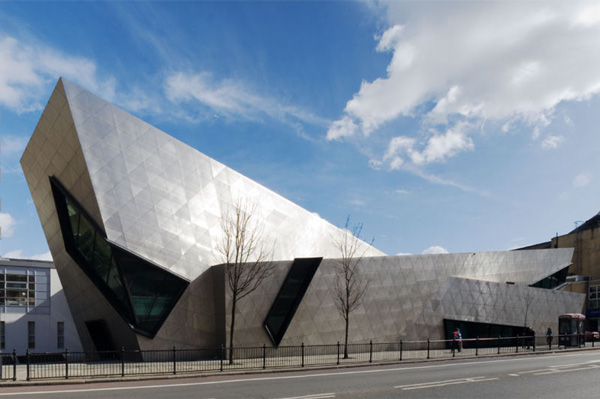
Graduate Centre London Metropolitan University


(4 vote, 60.00% worth checking out)
Location:
& checkout the other sites nearby
166-220 Holloway Road
London
N7 8DB
United Kingdom
coordinates:
open coordinates in google maps
open coordinates in apple map
Building names(s): Graduate Centre London Metropolitan University
Architect/Designer: Daniel Libeskind
Images: add an image <== click Here
166-220 Holloway Road
London
N7 8DB
United Kingdom
coordinates:
open coordinates in google maps
open coordinates in apple map
Building names(s): Graduate Centre London Metropolitan University
Architect/Designer: Daniel Libeskind
Images: add an image <== click Here
Completion date: 2004
function(s): academic, university
getting there:
tube: Holloway Road station. As you come out of the station onto Holloway Road, turn right (heading south towards the town center). The building is very visibly across the road on your left in a couple of minutes’ walk.
The exterior is directly on the street, but the building is not normally open to the public. To visit the interior, look out for opportunities in London’s annual late- September ‘open house’ weekend.
suggested on: 14 June 2009 |
Suggested By LT
1 comment/review
Simon Glynn says:
Jun 14, 2009
Three dramatically intersecting blocks clad in stainless steel make up this graduate center for the London Metropolitan University, angled as if the metallic bricks had been hurled into this drab streetscape and forced themselves into the ground. The defining character of the building comes from the uncompromising angles created by the three intersecting blocks. The staircase is slightly dizzying to walk up, as one wall leans over above the handrail. Doorways and windows are irregular, even in the lecture rooms. The blinds, essential since large windows from the lecture rooms give directly onto the pavement of Holloway Road, need special guide-wires and pulleys so they descend parallel to the sloping windows, rather than where gravity would take them.
In this graduate center Libeskind has used much of the imagery that made him famous in the Jewish Museum Berlin and, more recently, the UK’s Imperial War Museum North. The windows as acute-angled slashes cut in a metal facade were symbolic of catastrophic destruction in both those earlier buildings – but the same vocabulary here is used without obvious symbolism or relevance. The building is certainly engaging, inside and out, and a dramatic landmark on a very un-dramatic road. And its peculiarity is not an extravagance, at a total building cost of less than £3 million. But part of what it shouts out is arbitrariness – a bold statement that, unlike Libeskind’s previous projects, seems to have too little to say.