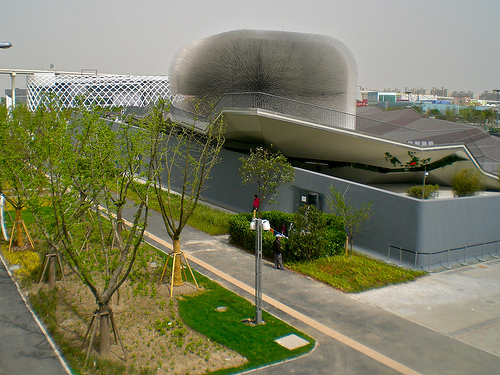
EXPO 2010 United Kingdom Pavilion
Rate this: Use the stars above to vote, five stars being the highest rating.
Location:
Show on map
EXPO 2010 Shanghai
Zone C of the Expo Site
Shanghai
China
coordinates:
lat 31.1862984, long 121.4725800
Building names(s): EXPO 2010 United Kingdom Pavilion
Architect/Designer:
Thomas Heatherwick
architect website:
Other Information:
Completion date: 2010
Function:
Theme: Building on the Past, Shaping Our FutureHeight: 20 metres
Construction: formed from 60,000 slender transparent fibre optic rods, each 7.5 metres long and each encasing one or more seeds at the end.
website: www.ukshanghaiexpo.com
Highlights: Seed Cathedral, Wrapping Paper – Fibre optic rods – draw daylight inwards to illuminate the interior during the day | internal light sources inside each rod allow the whole structure to glow at night. As the wind moves past, the building and its optic “hairs” gently move to create a dynamic effect.
getting to the expo site:
Metro Line Entrance/exit : Puxi Section - Madang Road Station of Metro Line 13
Ground Entrance/exit :
Puxi Section - Entrance/exit at Luban Road, South Xizang Road, Bansongyuan Road
Pudong Section - Entrance/exit at Bailianjing, West Gaoke Road, Shangnan Road, Changqing Road, Houtan
Water Entrance/exit:
Extra-Site Water Gate - Dongchang Road Water Gate, Qichangzhan Water Gate, Shiliupu Water Gate, Qinhuangdao Road Water Gate
Intra-Site Water Gate
Dock 1 (Miaojiang Road • Wangda Road)
Dock 2 (Expo Avenue • Bailianjing Road)
Dock 6 (Houtan Garden)
Intra-Site Transport
Metro Line
Metro Line 13 is designed to facilitate visitors’ travelling between Pudong and Puxi Sections. There are Madang Road Station, Lupu Bridge Station, and Expo Avenue Station on the line.
Ground Transport
Five bus routes, including two sightseeing routes, are designed to facilitate visitors’ touring in Pudong or Puxi
Section and traveling between the two sections.
Water Transport
Five ferry routes are designed to facilitate visitors’ traveling between Pudong and Puxi Sections.
Last modified: 20 May, 2010 | Suggested By LT


(4.83 out of 5)
The Seed Cathedral sits in the centre of the UK Pavilion’s site, 20 metres in height, formed from 60,000 slender transparent fibre optic rods, each 7.5 metres long and each encasing one or more seeds at its tip. During the day, they draw daylight inwards to illuminate the interior. At night, light sources inside each rod allow the whole structure to glow. As the wind moves past, the building and its optic “hairs” gently move to create a dynamic effect.
Heatherwick previously experimented with texture and architecture at a much smaller scale with his Sitooterie projects. The Seed Cathedral is the ultimate development of this.
Inside the darkened inner sanctum of the Seed Cathedral, the tips of the fibre optic filaments form an apparently hovering galaxy of slim vitrines containing a vast array of embedded seeds. The seeds have been sourced from China’s Kunming Institute of Botany, a partner in Kew Royal Botanic Gardens’ Millennium Seed Bank Project. Visitors will pass through this tranquil, contemplative space, surrounded by the tens of thousands of points of light illuminating the seeds.
hese fibre optic filaments are particularly responsive to external light conditions so that the unseen movement of clouds above the Seed Cathedral are experienced internally as a fluctuating luminosity. The studio’s intention is to create an atmosphere of reverence around this formidable collection of the world’s botanical resources; a moment of personal introspection in a powerful silent space.
The Seed Cathedral is made from a steel and timber composite structure pierced by 60,000 fibre optic filaments, 20mm square in section, which pass through aluminium sleeves. The holes in the 1 metre thick wood diaphragm structure forming the visitor space inside the Seed Cathedral were drilled with great geometric accuracy to ensure precise placement of the aluminium sleeves through which the optic fibre filaments are inserted. This was achieved using 3D computer modelling data, fed into a computer controlled milling machine.
This accuracy ensures that the Seed Cathedral’s fibre optic array creates an apparent halo around the high structure, with the fibre optic filaments rippling and changing texture and reflectivity in the gentlest wind. The wavering external surfaces of the Seed Cathedral form a delicate connection between the ground and the sky.