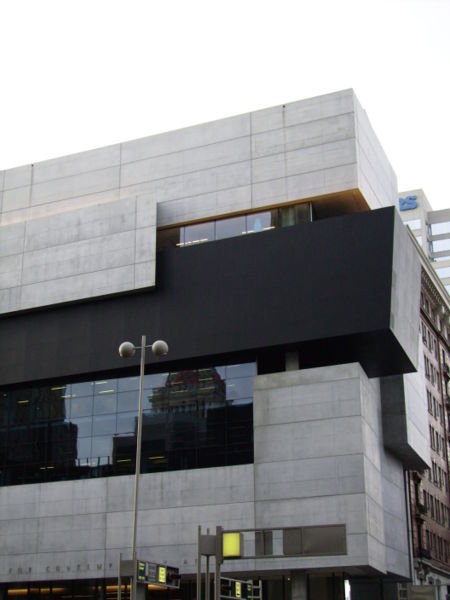
Contemporary Arts Center
Rate this: Use the stars above to vote, five stars being the highest rating.
Location:
Show on map
44 E. 6th Street
Cincinnati
Ohio 45202
USA
coordinates:
39.1027184 -84.5120316
Building names(s): Contemporary Arts Center / CAC / Lois & Richard Rosenthal Center for Contemporary Art
Architect/Designer: Zaha Hadid
Images: add an image <== click HereOther Information:
Completion date: Spring 2003
Function:
getting there:Metro/SORTA serves the Cincinnati area in Ohio. Most of the routes stop close to CAC. You can plan your trip and download a schedule on the Metro/SORTA web site. Just type “CONTEMPORARY ARTS CENTER” into the destination field.
Southbank Shuttle/TANK serves Northern Kentucky with service into Downtown Cincinnati; many TANK routes stop at CAC’s doorstep. Visit the Southbank Shuttle/TANK web site for schedules.
Hours:
Monday: 10 am-9 pm (5 pm-9 pm free admission)
Tuesday: Closed
Wednesday – Friday: 10 am-6 pm
Saturday & Sunday: 11 am-6 pm
Cost: $7.50
website: www.contemporaryartscenter.org
Building Footprint: 11,000 square feet
Total Area: 80,000 square feet
Project Cost: $34 million (including land acquisition and endowment)
Last update: 15 June, 2010 | Suggested By LT


(7 votes, average: 3.86 out of 5)
“The public lobby, where everyone enters, is downtown and central to the city so people who are just walking around can go in and have a coffee downstairs or hang around the lobby or go upstairs to quickly see a show. It is a very accessible building.
It’s not a compact building and there is a degree of transparency on the ground and above. So it’s not only how we use it, but also how we pass through it.
Every time you confront the space you have a different experience”.
Major Design Features:
Urban Carpet:
To draw in pedestrian movement from the surrounding areas and create a sense of dynamic public space, the entrance, lobby and lead-in to the circulation system are organized as an “Urban Carpet.” Starting at the corner of Sixth and Walnut, the ground curves slowly upward as it enters the building, rising to become the back wall. As it rises and turns, this Urban Carpet leads visitors up a suspended mezzanine ramp through the full length of the lobby, which during the day functions as an open, daylit, “landscaped” expanse. The mezzanine ramp continues to rise until it penetrates the back wall, on the other side of which it becomes a landing at the entrance to the galleries.
Jigsaw Puzzle:
In contrast to the Urban Carpet, which is a series of polished, undulating surfaces, the galleries are expressed as if they had been carved from a single block of concrete and were floating over the lobby space. Exhibition spaces vary in size and shape, to accommodate the great range of scales and materials in contemporary art. Views into the galleries from the circulation system are unpredictable, as the stair-ramp zig-zags upward through a narrow slit at the back of the building. Together, these varying galleries interlock like a three-dimensional jigsaw puzzle, made up of solids and voids.
Skin/Sculpture:
The building’s corner location led to the development of two different, but complementary, facades. The south facade, along Sixth Street, forms an undulating, translucent skin, through which passersby see into the life of the Center. Offices – organized along this side to provide daylit working environments and views of the city – provide the facade with human animation. The east facade, along Walnut, is expressed as a sculptural relief. It provides an imprint, in negative, of the gallery interiors.