Christ The Hope of the World Church
Rate this: Use the stars above to vote, five stars being the highest rating.
Location:
Show on map
Donaucitystrasse 2, 22.
Bezirk
Vienna
Austria
coordinates:
48.2330666 16.4151669
Building names(s): Christ The Hope of the World Church / Donaucity kirche
Architect/Designer:
Heinz Tesar with Marc Tesar
architect website:
Other Information:
Completion date: 2000
Function: church
website: http://www.donaucitykirche.at/Last modified: 29 June, 2011 | Suggested By LT

(8 votes, average: 4.25 out of 5)
(5 votes, average: 3.80 out of 5)
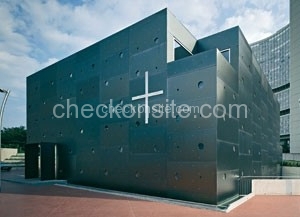
It is, at first sight, a black gleaming cuboid. A geometrical exercise in minimalism and restraint. Hard edges and clean facades predominate. Dark stainless steel cladding provides a sense of gravity. It appears as a monument, perhaps reminiscent of one of Kubrick’s mysterious obelisks in “2001: A Space Odyssey”. Yet the sombre starkness of the exterior is deceptive. It conceals a richness of symbolic forms that makes this a powerful and sensitive piece of modern religious architecture….
….The exterior of the Church is clad with dark chromium stainless steel plates that change from a deep purple to a shimmering silver in different light conditions. Chrome-plated steel is the hardest and most valuable steel, and is usually reserved for turbines or aircraft engines. The plates are dipped into acid, resulting in the dark colour. Tesar chose this material for its preciousness, its beautiful gloss and the way it emphasises the weight of the cubic volume. Bright silver bolts form a pattern across the faade, animating it and mediating between the rectangular plates and the circular porthole-type windows. These windows are perhaps the most striking feature of the Church. They allow the interior of the Church to be crosshatched with beams of light, and at night the Church glows softly like a lantern, or a lighthouse.
Internally the Church has a very different presence. Pale birch panelling on the walls and ceiling contrasts dramatically with the dark exterior and gives the interior a sense of warmth and vibrancy. The play of light through the round windows is especially significant in defining the Church’s character from day to day. The interior elements are minimal, monochromatic and simple. Incorporated into the birch lining of the eastern wall is a circle with a subtle golden cross inside it. The altar is monolithic, made from syenite and almost black in colour, with the pews arranged around it in a semi-circle. Internal porches are curved and echo the wave of the skylight. At the corners of the room are the Baptistery, the tabernacle and a Madonna. Heinz Tesar, with his son Marc, also designed the liturgical instruments of silver, ebony and chrome-plated steel….. read more at http://www.specifier.com.au/projects/religious/15974/Church-of-Christ-Hope-of-the-World.html
At a closer look the 20 by 20meters plan of the Roman Catholic church ‘Christ, hope of the World’ resembles a somewhat heavy cross with short arms since all corners of the box building are cut away in different degrees to give way for windows. The placement of the windows in the upper corners of the facades are having some architectonic similarities to the ‘el’-figures of Peter Eisenmann, but are used otherwise since the smallest cut into the box appears to South East, the cut in North East is a little larger, the North Western one even larger while the South Western one is stretching from ground level to the flat top of the building and partly used in the entrance porch next to the exit.
Protected by heavy metal facades made of steel chrome alloy plates measuring some 2400 by 1200 by 5millimetres the skin of the church could be compared to an armoured vehicle or humvee providing interior safety against the vandalism of the city. The exterior armour even seems to have been hit and penetrated twice since each plate has two circular openings. The biggest of the windows in a plate being 30centimetres in diameter while the other one minuscule and the plate itself secured by 16 steel bolts. The façade plates are organized in a vertical pattern while the neighbouring plates are moved one third (40centimetres) upwards or downwards giving some life or movement to the else way stern outer skin.
Like a turtle the austere heavy though perforated exterior shield is contradicted by a surprisingly soft and friendly looking interior. In fact all surfaces on the inside of the church are made of light wood, the walls and ceiling being of birch plywood plates while the floor is made of small 1 by 25centimetres laminated maple blocks. Even the benches are mainly made of birch plywood carried on small steel columns.
read more at rockwool.dk