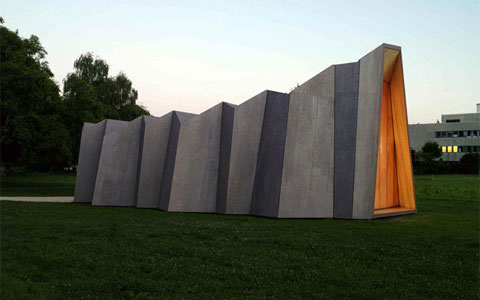
Chapelle de St-Loup


(6 vote, 90.00% worth checking out)
Location:
Show on map & checkout the other sites nearby
Route de Saint-Loup 1318
Pompaples
Switzerland
coordinates: 46.6672935,6.5034933
open coordinates in google maps
open coordinates in apple map
Building names(s): Chapelle de St-Loup
Architect/Designer: Local Architecture
architect website: http://www.localarchitecture.ch
Images: add an image <== click Here
Show on map & checkout the other sites nearby Route de Saint-Loup 1318
Pompaples
Switzerland
coordinates: 46.6672935,6.5034933
open coordinates in google maps
open coordinates in apple map
Building names(s): Chapelle de St-Loup
Architect/Designer: Local Architecture
architect website: http://www.localarchitecture.ch
Images: add an image <== click Here
Completion date: 2008
function(s): chapel, religious
credentials/awards: 2009 May BOM, BOM
This building serve as temporary chapel building to accommodate religious worship for 18 month. (for the construction period)
suggested on: 23 December 2008 |
Suggested By M2S
3 comments/reviews
Europaconcorsi says:
May 7, 2009
Materials:
Plywood / laminated wood 60 mm for the roof, 40 mm for facades and floors, structural panels are cut by a saw with numerical (CNC) according to drawings prepared by IBOIS 3D.
The assemblies are provided by metal plate folded and nailed to 3mm.
Bituminous sealing cover the whole structure. The outer skin is made of wood panels 3plis 19mm Lazure, mounted on a lambourdage assembled and open joints to ensure the flow of rainwater.
Gable facades are stabilized by a backbone of stud and fir beams diagonals. Senior textile copper dress the outside, while panels of 10 mm polycarbonate honeycomb transparent ensure the tightness on the inside.
archicentral says:
May 7, 2009
An origami chapel for Catholic nuns has been built in the small village of St Loup in the south of Switzerland. The temporary building, by Lausanne-based Local Architecture, uses structural principles inspired by folded paper. Local won a competition to restore the nuns’ ageing 200-year old chapel in 2007, and needed to find the nuns somewhere to worship for the 18 months of building work. The architect suggested that a new intermediary structure could be more cost-effective, weather-friendly and appropriate than a marquee.
The architect approached engineers from ETH university in Zurich for help building a cheap timber structure. In a stroke of luck, the studio was put in touch with professor Yves Weinhard and Dr Hani Buri, who were researching ways to use folding to create strength and rigidity in small structures.
‘We didn’t realise what they were working on, but we saw that it was an amazing opportunity to do something totally new,’ says Local Architecture principle Antoine Robert-Grandpierre. ‘We wanted to create something religious, to produce the feeling that you have in only a chapel. This was a good opportunity.’
The wooden chapel is small, delicate and beautiful. Its 7m high timber walls fold to support the roof as it rises up to 12m over the nave. At the west end is a wall of copper-coated glass. The complex shape of the wooden panels was produced by digital laser-cutting but it was constructed by local carpenters. The chapel has been designed to be dismantled and rebuilt elsewhere at the end of its term.
The Deaconesses needed a temporary structure for their community’s religious activities during an extensive renovation of their motherhouse, and a novel method recently developed in IBois for generating architectural forms based on origami provided an ideal solution. The chapel was built in less than two months, and the entire project took less than 6 months from start to finish. The structure is both economical and ecological, because it was built using timber panels and without the need for a pre-exisiting linear framework.
The architects wanted the chapel to capture the form of a basilica with one rounded nave. In the chapel, two symmetrical, slightly bent zigzag lines define a corrugated form in plan, rising to a tip that brings to mind a small belfry. The chapel’s huge wooden panels, joined by folded metal plates, enable the structure to stay upright without a traditional linear framework. And transparent plastic panels in the gable side facades, covered with fabric, allow natural light to enter the chapel. “Working from the traditional interior of protestant churches — the variations in width and height of the nave — this project proposes a space whose horizontal and vertical dimensions vary via a series of folds that give rhythm to the interior volume,” the architects explain.
The wooden chapel is the first full-scale structure that incorporates design and structural analysis based on Weinand and Buri’s method of generating novel geometrical forms. They have created SHEL, a start-up company to further develop this unique combination of architecture and engineering.
Nico Saieh says:
May 7, 2009
In the summer of 2007, Localarchitecture and architect Danilo Mondada were awarded the contract to renovate the mother house of the Deaconess Community of St-Loup. The commission involves the complete renovation of a historic building, including the community’s main chapel.
It was immediately apparent the mother house would have to be closed for the duration of the building works, in other words for 18 months starting from the summer of 2008. Instead of settling for a standard solution, like renting a tent or containers, the architects suggested building a temporary chapel to accommodate religious worship during the construction period.
Localarchitecture, which has a special interest in timber construction and new structural solutions, has made its name with several works exploring traditional and contemporary wood construction techniques. In this instance, the architects suggested working in partnership with Hani Buri and Yves Weinand from the IBOIS laboratory at the EPFL (École Polytechnique Fédérale de Lausanne), whose ongoing research into folded structures seemed particularly interesting and appropriate for this project. The team developed a structure using timber panels, which makes it possible to cover large areas with fine sections. The shape was generated using computer software that calculates the load-bearing structure, determines the dimensions and transmits this information to the machine that cuts out the 6-cm thick timber panels.
Built directly on the ground, the new chapel blends subtly and delicately with the landscape. The structure, which lies along the axis of the east-west valley and is open at each end, lets in plenty of natural light. Interpreting the traditional layout of protestant churches with their variations in width and height between transept and nave, the design creates a space whose horizontal and vertical dimensions vary via a series of origami-like folds, which give rhythm to the interior and exterior of the building. The folded volume generates a wide horizontal space at the entrance, before closing in and rising up to become vertical towards the centre of the chapel. Each fold in the facade reflects the light differently and thus emphasizes the progression and elongation of the volume. The structure punctuates the interior space, while creating an atmosphere conducive to reflection.
Transparent plastic panels in the gable side facades, covered with fabric, allow natural light to enter the chapel. The frame of columns and diagonals resembles the structure of a stained-glass window.
The wooden chapel in St-Loup is the first full-scale structure that incorporates design and structural analysis based on computer method of generating novel geometrical forms, but it is also a bright example of the spatial reinterpretation of a traditional religious space in harmony with its environment.