Centre Pompidou-Metz


(3 vote, 86.67% worth checking out)
Show on map & checkout the other sites nearby 1, Parvis des Droits de l’Homme
Metz
57000
France
coordinates: 49.1077461,6.1800456
open coordinates in google maps
open coordinates in apple map
Building names(s): Centre Pompidou-Metz
Architect/Designer: Shigeru Ban + Jean de Gastines
Images: add an image <== click Here
Completion date: 2010
function(s): contemporary art, gallery, museum
function: gallery
website: www.centrepompidou-metz.fr
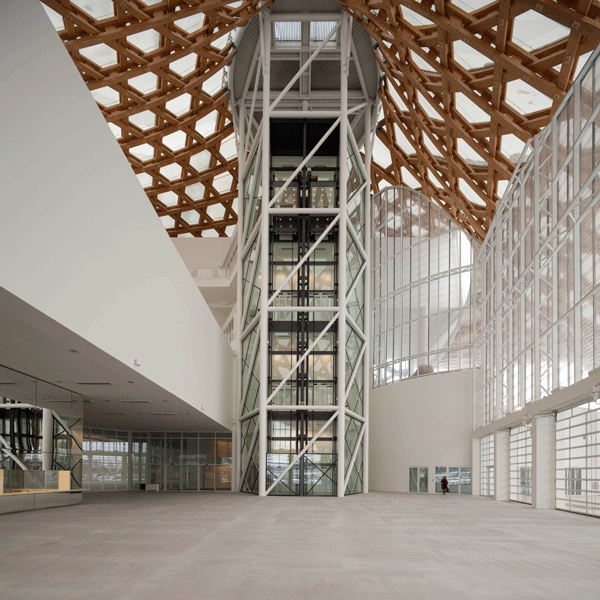
building description: Centered around a 77m high spire, the roof spans an area of 8,000 m2, made from a glue-laminated timber mesh resembles the cane-work pattern and technical properties of a Chinese hat. The mesh is highly resilient, requires minimal support, and it is coated in a waterproof membrane made of white fiberglass and Teflon. three galleries in the shape of rectangular (parallelepipedic) tubes weave through the building at different levels, jutting out through the roof with huge panoramic windows, angled towards landmarks such as the metz cathedral, the metz station and the seille park.
height: 77m
total floor area: 11330m2
structure: reinforced concrete, steel frame, wooden
area: 10,660m²
getting there:
On foot a 2-minute walk from the high-speed TGV train station in downtown Metz, a 10-minute walk from historical downtown.
By car via the A4 (Paris / Strasbourg) and A31 (Luxembourg / Lyon) motorways, exit Metz Centre.
700 space car park.
By train to the high-speed TGV train station Metz Ville. Direct trains: just 1 hr 20 min from Paris, 40 min from Luxembourg Ville.
To the Lorraine TGV train station (35 km from Metz, shuttle service) Direct trains: 2 hrs from Lille Europe,
4 hrs from Rennes, 5 hrs from Bordeaux, 2 hrs 40 min from Frankfurt.
By plane to the Metz-Nancy Lorraine airport (18 km / 20 min), the Luxembourg airport (69 km / 45 min), the Saarbrucken airport (79 km / 1 hr), the Zweibrücken airport (110 km / 1 hr 20 min).
3 comments/reviews
R Moore says:
Aug 11, 2010
… designed by the Japanese architect Shigeru Ban, in collaboration with the Frenchman Jean de Gastines and the Londoner Philip Gumuchdjian. Ban is famous for his inventive structures in paper, cardboard, bamboo and timber, especially after disasters including the 1995 Kobe earthquake, but also for delightful private houses in which walls disappear or take the form of huge curtains. His concept for Metz was a big billowing all-encompassing roof of Teflon supported on a timber lattice, under which accommodating skirt would be a loosely assembled stack of galleries, and a big atrium for people to do what they will. As in the Pompidou in Paris the relation to outdoor space is important, even if the periphery of the Lorrainois city is less vibrant than the Marais. A public garden the size of the piazza outside the original Pompidou has been installed next to Ban’s building.
The Pompidou’s concept sounds generous and creative, and the choice of Ban promising, but it was with mounting desolation that I toured it last week. The Ban approach demands both lightness of touch and grace in the details. This kind of building should feel as if it has just landed, and could as easily move on. Here, cross-bred with the concept of a civic monument, it has become ponderous and confused. Different materials – wood, Teflon, polycarbonate, steel, plaster – collide in unappetising ways. The atrium feels redundant, the gallery spaces under-considered. Steel takes over from the timber structure, no doubt for practical reasons, which compromises its essential simplicity.
Natasha Edwards says:
Aug 11, 2010
…just south of the station, located on pretty much the spot where the Roman amphitheatre stood a couple of thousand years ago, in what is destined to become an entire new district of parks, housing, shops and offices. In the meantime, the best way to reach it is by walking through the station to the Arènes/Quartier Amphitheatre exit.
The spectacular building, designed by the Japanese architect Shigeru Ban and his French associate Jean de Gastines, seems to hover over the ground, with a canopy-like translucent white roof over a web of woven spruce (think of it as large-scale caning), façades that lift up and three long, superposed galleries (the biggest temporary exhibition space outside Paris), each aligned to give a telescopic view to a strategic point in the city: the Cathedral, the station and the Parc de la Seille.
read more….Natasha’s advice and tips on the town of Metz and where to stay
Susan James says:
Aug 11, 2010
Eighty-seven minutes from Paris by fast train, this instant icon stands like an unexpected Teflon tent anchored to the ruins of the Roman amphitheater buried beneath it. Inside is an eclectic array of art on loan from the 60,000-piece collection of Paris’ Pompidou Centre.
A paved path led me on a two-minute walk from the railroad station to the museum, designed by architects Shigeru Ban, Jean de Gastines and Philip Gumuchdjian. Beneath a steel-and-wood lattice roof covered with translucent Teflon membranes, natural light floods four floors of exhibition rooms. The museum has no permanent collection or storage space; artworks will flow in and out as special shows open and close.