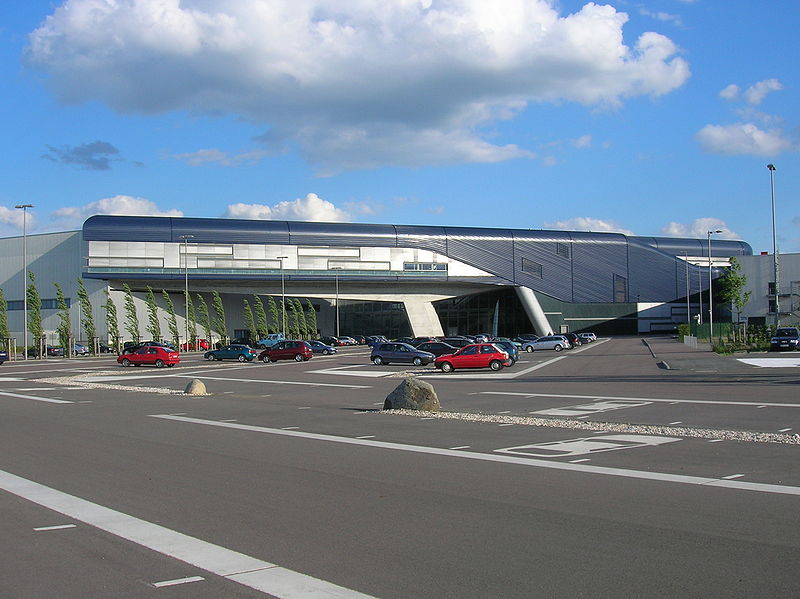
Central Building – BMW Plant
Rate this: Use the stars above to vote, five stars being the highest rating.
Location:
Show on map
BMW Allee 1
BMW AG Werk
Leipzig
D-04349
Germany
coordinates:
lat 51.4082794, long 12.4433041
Building names(s): Central Building – BMW Plant
Architect/Designer: Zaha Hadid
Images: add an image <== click HereOther Information:
Completion date: 2005
Function:
Hours: Monday to Friday – 08:00 to 17:30website: www.bmw-plant-leipzig.com
Cost & Booking: Guided Tours available for bookings go to bmw website
Guided tours are limited to around 30 people, making advance booking necessary.
Groups of up to 30 people can request a tour. The admission fee will be 120 Euro for the whole group with a maximum of 30 participants.
Total area: 25,000 square meters
Last modified: 9 July, 2009 | Suggested By kiwi kid


(3 votes, average: 4.33 out of 5)
In October 2004 BMW moved into the Central Building at the new Plant Leipzig premises.
The building’s design facilitates a radical new interpretation of open office landscape, delivering an even more engaging experience of connectivity and transparency within the demanding functionality.
It was the client’s objective to translate industrial architecture into an aesthetic concept that complies equally with representational and functional requirements.
In the transition zones between manufacturing halls and public space, the Central Building acts as a “mediator” impressing a positive permanent impact upon the eye of the beholder in a restrained semiotic way.
Planning Constraints
When the Central Building was designed, the planning and layout of the adjacent fabrication buildings had already been finalized, leaving a narrow stretch of open land to be filled.
With a wide range of suppliers pre-appointed for the rest of the factory many fit-out elements were selected from a standard range of products, emphasising BMW’s industrial approach to office spaces.
Concept/Programme – The Central Building as Communication Knot
The Central Building is the nerve-centre of the whole factory complex with all the building’s activities gathering and branching out again from here.
The knot connects the three main manufacturing departments of Body-in-White, Paint Shop and Assembly while serving as the entrance to the plant.
The whole expanse of this side of the factory is oriented and animated by a force field emanating from the central building. All movement converging on the site is funneled through this compression chamber squeezed in between the three main segments of production.
Such planning strategy applies not only to the cycles and trajectories of workers and visitors but also the production line, which traverses this central point.
This dynamic focal point of the enterprise is visually evident in the proposed dynamic spatial system that encompasses the whole northern front of the factory and articulates the central building as a point of confluence and the culmination of various converging flows.
The central area as a “market place” is intended to enhance communication by providing staff with an area with which to avail themselves of personal and administrative services.
This organisation of the building exploits the obvious sequence of front-to-back for the phasing of public to quiet activities.
The primary organising strategy is the scissor-section connecting the ground floor and first floor in a continuous field.
Two sequences of terraced plates, like giant staircases, step up from north to south and from south to north capturing a long connective void between them.
One cascade commences close to the public lobby overlooking the forum to reach the first floor in the middle of the building. The other starts with offices at the south end moving up to meet the first cascade then moving all the way up to the space projecting over the entrance.
At the bottom of this void is the auditing area as a central focus of everybody’s attention. Above the void ‘open to view’ the half-finished cars move along their tracks between the various surrounding production units.
The cascading floor plates are large enough to allow for flexible occupation patterns.
The advantage here lies in the articulation of recognisable domains within an overall field. With a global field, it opens up to visual communication more possible than with a single flat floor plate.
The integration of workers is facilitated by an overall transparency of the internal organisation. The mixing of functions avoid the traditional segregation of status groups.
A series of engineering and administrative functions are located within the trajectory of the manual workforce’s daily movements.
White collar functions are located both on ground and first floor. Equally Blue Collar social spaces are located on both floors thus preventing the establishment of exclusive domain.
The intrinsic problems of a large car-park in front of a building were avoided by turning it into a dynamic spectacle in its own right.
The inherent dynamism of vehicle movement and the ‘lively’ field of car bodies is revealed in the arrangement of parking lots which let the whole field move, colour and sparkle with swooping trajectories culminating within the building. Here cars swoop underneath, setting down visitors into the glazed public lobby allowing views deep into the building.
Materials
Self-compacting concrete with a roof structure assembled with a series of H-steel beams.
Architects can’t shake their fascination with industrial buildings. Icons of functionalism such as Fiat’s Lingotto factory in Turin, the work of engineer G. Matté Truco (1926), and Peter Behren’s AEG turbine factory in Berlin (1910), to name two relics of another era, still loom large in the imaginations of architects romanced by the buildings of manufacturing. But in our postindustrial, information-driven society, few factories manage to create inspired architecture from the exigencies of the assembly line.
In 2002, the German auto giant BMW invested in a high-profile competition to design a Central Building at its factory on the outskirts of Leipzig, a $1.55 billion complex where 5,000 employees can produce up to 650 of BMW’s 3-Series sports sedans daily. From a field of 25 international architects, the company picked Pritzker laureate Zaha Hadid, whose sophisticated design turned conventions of factory design on their ear. Blue-collar factory workers and white-collar managers commingle in a fluid matrix of automotive production and administration. Unfinished auto bodies on their way to the assembly line parade silently on cagelike conveyor belts suspended above workers lunching in the corporate canteen or laboring in their cubicles. “Our idea was always to challenge the typology,” says Hadid. “It took tremendous chutzpah for BMW to allow us to do this project.”
Though Hadid purports to shatter typologies, her building has no real precedent. It functions as a centralized node connecting three production buildings, designed by BMW’s own real estate and facility management group and completed in 2004, each of which contains a distinct segment of the assembly sequence: the fabrication of raw auto bodies (645,000 square feet), the paint shop (270,000 square feet), and finally the vast assembly hall (1,075,000 square feet), where painted shells are fitted out and released as finished luxury vehicles. well.
The Central Building is the active nerve-centre or brain of the whole factory complex. All threads of the building’s activities gather together and branch out again from here. This planning strategy applies to the cycles and trajectories of people – workers (arriving in the morning and returning for lunch) and visitors – as well as for the cycle and progress of the production line which traverses this central point – departing and returning again.
This dynamic focal point of the enterprise is made visually evident in the proposed dynamic spatial system that encompasses the whole northern front of the factory and articulates the central building as the point of confluence and culmination of the various converging flows.
It seems as if the whole expanse of this side of the factory is oriented and animated by a force field emanating from the central building. All movement converging on the site is funnelled through this compression chamber squeezed inbetween the three main segments of production: Body in White, Paint Shop and Assembly.
The organisation of the building exploits the obvious sequence of front to back for the phasing of public/busy to more withdrawn/quiet activities. The façade envelope is pulled in under a large diagonally projecting top floor. Here the car drop-off swoops underneath letting off visitors into the glazed public lobby.
The primary organising strategy is the scissor-section that connects groundfloor and first floor into a continuous field. Two sequences of terraced plates – like giant staircases – step up from north to south and from south to north. One commences close to the public lobby passing by/overlooking the forum to reach the first floor in the middle of the building. The other cascade starts with the cafeteria at the south end moving up to meet the first cascade then moving all the way up to the space projecting over the entrance. The two cascading sequences capture a long connective void between them.
At the bottom of this void is the auditing area as a central focus of everybody’s attention. Above the void the half-finished cars are moving along their tracks between the various surrounding production units open to view. The close integration of all workers is facilitated by the overall transparency of the internal organisation.
The mixing of functions avoids the traditional segregation into status groups that is no longer conducive for a modern workplace. A whole series of engineering and administrative functions is located within the trajectory of the manual workforce coming in to work or moving in and out of their lunch break. White collar functions are located both on ground and first floor. Equally some of the Blue Collar spaces (lockers and social spaces) are located on the first floor. Especially those internal reserve spaces that are waiting for full use in Phase 2 are allocated as social communication spaces to mix blue and white collar workers. This way the establishment of exclusive domain is prevented.