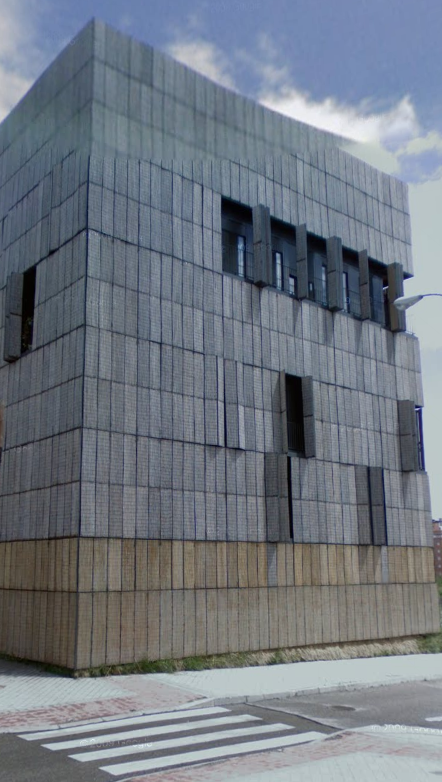
Carabanchel Social Housing
Rate this: Use the stars above to vote, five stars being the highest rating.
Location:
Show on map
Calle de los Clarintes 9-21
Madrid
28044
Spain
coordinates:
40.3713188 -3.7644067
Building names(s): Carabanchel Social Housing / Edificio Bambú
Architect/Designer: Foreign Office Architects
Images: add an image <== click HereOther Information:
Completion date: 2007
Function:
building awards: RIBA European Awards 2008Last update: 1 July, 2010 | Suggested By LT


(2 votes, average: 4.50 out of 5)
Caravanchel 16 is a simple rectangular 93-unit building. The apartments have various types and sizes. The building is organized around the north-south axis: that means it faces the harsh Spanish east-west sun for most of the day. To avoid the heat gain from the sun, the architects have covered the façades with a 1.5 metre terrace enclosed with bamboo shutters. Mounted on folding frames, they can be opened whenever the occupants want to. A constant play of shadow and light keeps going on throughout the day, making for interesting changes at the façades – it could very well be called a living façade!
The concrete framed box hides in its base a car park and generous storage rooms for each apartment. Elegant ramps reach inside the building from the place. The common parts are robust, white walls and galvanised handrails. The bedrooms are tiny but living spaces generous and all the rooms are easily reconfigurable. The louvres not only provide the necessary protection from the blazing summer sun, but also enhance security and, because they are completely under the control of each unit’s occupants, they also highlight the latter’s spatial independence.
Bamboo louvers mounted on folding frames, cover the facades of this new project, within Madrid’s Carabanchel public housing development in the city’s south suburbs. The basic parallelogram block hosts units of different sizes and shapes, and due to their tube-like interior shape, they all have a double east-west orientation, also allowing access to a private garden on the eastern side. The louvers not only provide the necessary protection from the blazing summer sun, but also enhance security, and as they are controlled entirely by each unit’s occupants, they aim to stress spatial independency.
The London-based architects based their design on a simple concept that is low-cost, sustainable and playful, experimenting with the standard ideas on social housing