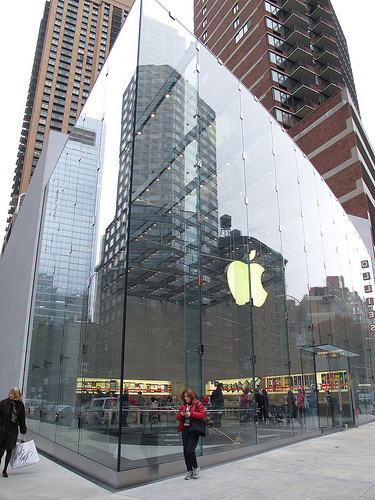
Apple Store Upper West Side


(2 vote, 100.00% worth checking out)
Location:
Show on map & checkout the other sites nearby
1981 Broadway
New York
10023
USA
coordinates: 40.7750740,-73.9826508
open coordinates in google maps
open coordinates in apple map
Building names(s): Apple Store Upper West Side
Architect/Designer: Bohlin Cywinski Jackson
Images: add an image <== click Here
Mon – Sun:
9:00 a.m. – 9:00 p.m.
Show on map & checkout the other sites nearby 1981 Broadway
New York
10023
USA
coordinates: 40.7750740,-73.9826508
open coordinates in google maps
open coordinates in apple map
Building names(s): Apple Store Upper West Side
Architect/Designer: Bohlin Cywinski Jackson
Images: add an image <== click Here
Completion date: 2010
function(s): retail, showroom
opening hours:
suggested on: 3 November 2011 |
Suggested By M2S
1 comment/review
Details says:
Nov 4, 2011
Barrel vault insulated glass roof
The transparency of the roof over the main retail area is heightened by the use of delicate and finely detailed steel trusses spanning the width of the building. The trusses support plate steel purlins which in turn support large insulated glass units, each curved to follow the radius of the barrel vault roof and each weighing in excess of 1 metric tonne designed to resist high snow drift loads.
Structural glass wedge
The glass wedge is a wholly structural glass assembly which follows the 60 degree angle made between Broadway and 67th St. The two glass facades, 30m and 13m long respectively, rise to 13m in height and follow the gentle radius of the barrel vault roof behind. The weight of the roof is carried by the 13m high glass fin columns on the facade.
Wedge structural systems
To accommodate and transfer all loads the wedge is divided into 6 structural zones, each of which combine to form local structural systems. Zones A, B, C and D take lateral loads and transfer them to the roof and ground, as well as bracing the structure in lateral directions. Zones E and F brace zones A, B, C and D against wind and seismic loads. Zones A and D also brace each other.
Each façade panel is lamination-spliced from smaller 6m panels to form 3-ply 12m full height monolithic panels, much in the same way as ply wood is produced, which are bolted to their neighbour in each structural zone to create four separate glass shear walls. These shear walls form the entire lateral stability system for the glass wedge creating a stiff box which needs to be isolated from the more flexible steel frame behind to prevent load transfer and complex stress concentrations.
The doorway is created by structurally bridging glass panels above the door against the adjacent panels. These panels also take the weight of the 1 metric tonne logo which hangs from the wedge roof purlins.
Wedge roof
The wedge roof is similarly made up of lamination-spliced jumbo panels up to 12m long, which also employ the new technique of cold bending to develop the gentle curve to match the barrel vault. This technique forces a curve into the individual plies by clamping and physically distorting the layers of glass and interlayers before laminating. Once the lamination process is complete, the bond between the glass and interlayer keeps the curve without the distortion typically associated with hot-bent panels.
These cold bent panels are then bolted together to form a horizontal “beam” or “diaphragm” which spans 20m between the stone parapets laterally bracing the façade panels against forces such as seismic acceleration and wind pressures.
Connections
The wedge structure utilises several different steel patch fittings, each ostensibly identical, connecting individual panels with their neighbour in various combinations of promoting or resisting movements. The details hidden within each fitting, the diaphragm roof and façade shear walls funnel forces into clear and distinct load paths through the wedge effectively resisting all loads.
Connections between the glass elements are a focus of the design and refinement. It is necessary to analyse the key connections where holes and bolts in glass cause high stress concentrations. Solid modelling techniques are employed to establish behaviour and feasibility which are benchmarked against our experience and testing results.
Helical all-glass stair
A final hidden structural glass feature, at least from street level, is the helical glass stair which runs from the ground floor into the basement. This all-glass structure, formed of steel-bolted chemically-tempered laminated glass panels, is based around the cylindrical core at the centre. Glass beams cantilever out from the cylinder using opposing edges of the cylinder as balance and fulcrum. Curved stringer panels are bolt-spliced to form continuous beams which span between the cantilevers forming the outer ribbon and balustrade. The treads span between these stringers and the cylinder and themselves play a key role in the overall stability of the structure – the rise and offset of each tread stabilises the stringers against overturning which in turn stabilise the cantilever beams allowing the structure to function as a complete whole.